
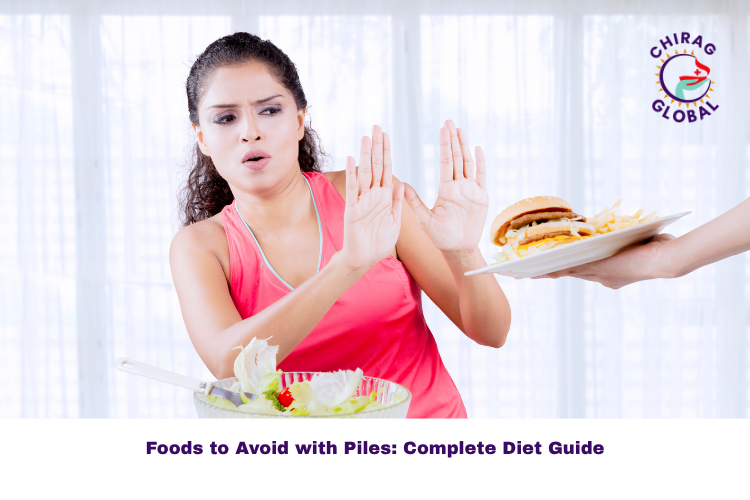
Diet is at the centre of every piles management and prevention plan — and that means knowing not just what to eat, but what to avoid. For patients managing active haemorrhoids or recovering from treatment, certain foods to avoid with piles can make the difference between a smooth recovery and a painful flare-up. For patients trying to prevent recurrence, the same list applies permanently.
At Chirag Global Hospital in Bangalore, our proctologists give every patient a personalized dietary briefing. This blog captures the core foods to avoid with piles in the Indian dietary context — with the reasons why each one causes problems, so you understand the logic and not just the list.
Why Diet Matters So Much for Piles
Piles are fundamentally a disease of the anal cushions, driven primarily by increased pressure during defecation. That pressure comes from hard, dry stools that require straining to pass. The foods that cause hard stools, worsen constipation, or irritate the inflamed anal tissue are therefore the foods to avoid with piles.
Equally important is what you should eat.
Category 1: Low-Fibre and Refined Foods
This is the most important category of foods to avoid with piles. Refined grains have had their fibre removed during processing, leaving behind easily digested starch that produces small, hard, compact stools.
White rice (polished): The staple of most South Indian diets, but almost entirely fibre-free after milling. Replace with brown rice, red rice, or millets like ragi and jowar.
Maida (refined flour): White bread, naan, paratha made from maida, biscuits, cakes, and most street food coatings. Maida produces constipating stools and has negligible nutritional value.
Processed breakfast cereals (not oats): Cornflakes, rice puffs, and most flavoured cereals. Despite their ‘healthy breakfast’ branding, most are low in fibre and high in sugar.
Instant noodles and ready-to-eat meals: Almost zero fibre, high sodium (which draws water away from the colon, hardening stool).
Category 2: Spicy Foods
Spicy food does not directly cause haemorrhoids, but it is one of the most significant foods to avoid with piles when haemorrhoids are already present. Capsaicin — the active compound in chilli — is not fully digested. It passes through the intestine and is excreted, causing direct irritation of the inflamed haemorrhoidal tissue during defecation.
The result: increased burning, itching, and post-defecation pain that can last for hours. Patients who manage piles well on all other fronts often sabotage their recovery with a chilli-heavy meal.
Avoid during active piles: Chilli-heavy curries, rasam, sambhar with excess chilli, raw chilli in chutney, spicy street food (chaat, misal), non vegetarian food with excess of masala
During recovery after laser treatment: A spice-free or very mild diet is recommended for the first 2 to 3 weeks post-procedure
Category 3: Alcohol
Alcohol is among the most damaging foods to avoid with piles because it operates through multiple mechanisms simultaneously:
Dehydration: Alcohol is a diuretic — it causes the kidneys to produce more urine, drawing fluid away from the colon and hardening stool.
Reduced gut motility: Alcohol slows intestinal movement, increasing constipation risk.
Anal irritation: Alcohol metabolites are excreted partially through the rectal mucosa and directly irritate inflamed haemorrhoidal tissue.
Liver impact: Chronic alcohol use affects portal venous pressure, which directly influences the venous pressure in the rectal plexus.
During an active flare-up or post-operatively, alcohol should be completely avoided.
Category 4: Red and Processed Meat
Red meat (mutton, beef, pork): High in fat, low in fibre, slow to digest. Red meat significantly slows colonic transit, increasing the time stool spends in the colon, how much water it loses, and how hard it becomes.
Processed meats (sausages, salami, ham): Extremely low fibre, high sodium and preservatives. These are among the most constipating foods available and are foods to avoid with piles regardless of grade.
Category 5: Dairy (For Some Patients)
Dairy products — particularly full-fat milk, paneer, and cheese in large quantities — can worsen constipation in patients who are lactose-sensitive (a common trait in the Indian population). This is not universal: curd (dahi) and buttermilk are actually beneficial for gut health and are not foods to avoid with piles for most patients.
Limit or avoid: Large quantities of full-fat milk, cream, heavy paneer curries
Continue or increase: Curd, buttermilk, lassi (without added sugar) — these support gut bacteria
Category 6: Caffeinated Beverages in Excess
Moderate tea and coffee consumption (1 to 2 cups per day) is generally fine. Excessive caffeine — 4 to 5 cups of strong tea or coffee daily — has a mild dehydrating effect and can irritate the lower gut in sensitive individuals. More importantly, many patients substitute caffeine for water, significantly reducing their total fluid intake without realizing it.
Visit Chirag Global Hospitals.
Quick Reference: Foods to Avoid with Piles
| Food | Why It’s Problematic | Swap For |
| White rice | No fibre, hardens stool | Brown rice / ragi / jowar |
| Maida products | No fibre, constipating | Whole wheat atta bread/roti |
| Spicy food | Irritates haemorrhoidal tissue | Mild, turmeric-based cooking |
| Alcohol | Dehydrates, slows gut | Coconut water, nimbu pani |
| Red / processed meat | Low fibre, slow transit | Dal, legumes, paneer |
| Fried food | Slows gastric emptying | Steamed / grilled / cooked options |
| Excess coffee/tea | Mild dehydration | Herbal tea, warm water with lemon |
Frequently Asked Questions
Q: Can I eat spicy food at all if I have piles?
A: During an active flare-up or post-procedure recovery, spicy food should be completely avoided. During remission (no active symptoms), small amounts of mild spice are generally tolerable. Very spicy food is one of the most reliable triggers for symptom exacerbation and should be a permanent food to avoid with piles for patients prone to flare-ups.
Q: Is curd good or bad for piles?
A: Curd (dahi) and buttermilk are beneficial for piles management — they support gut bacteria diversity, aid digestion, and are hydrating. Full-fat milk in large quantities may worsen constipation in lactose-sensitive individuals. Curd is not a food to avoid with piles — it is a food to include.
Q: How long before my piles diet starts making a difference?
A: Dietary changes — particularly reducing refined grains and increasing fibre, combined with adequate water — typically produce measurably softer stools within 3 to 5 days. Symptom improvement (reduced bleeding, less discomfort) usually follows within 2 to 4 weeks of consistent dietary management.
Q: Does eating red meat once a week cause piles?
A: Occasional red meat consumption is unlikely to cause piles in isolation. The problem is daily or near-daily consumption combined with low fibre intake, low water intake, and a sedentary lifestyle — all of which are common patterns in the same individuals. It is the dietary pattern as a whole that matters most.
Q: Are there any foods that actively shrink hemorrhoids?
A: No food directly shrinks haemorrhoids.Grade 1 haemorrhoids can often become asymptomatic with dietary management, but the underlying anal cushions remain.