

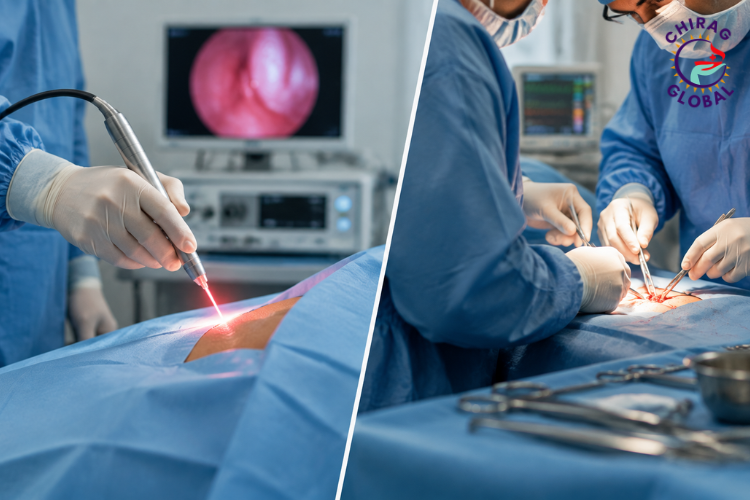
If you have been advised to undergo treatment for piles, you may come across several options, including conventional hemorrhoidectomy and newer minimally invasive techniques such as Laser Treatment for Piles.
Laser hemorrhoidoplasty uses controlled laser energy to treat hemorrhoidal tissue without removing as much tissue as conventional excisional surgery. Research comparing laser hemorrhoidoplasty with conventional hemorrhoidectomy has found advantages in several short-term outcomes, particularly postoperative pain, bleeding, operative time, and return to normal activities. However, laser treatment is not appropriate for every patient, and conventional surgery remains an important option for selected advanced cases.
At Chirag Global Hospitals, laser treatment is considered after evaluating the type, grade, symptoms, and severity of piles rather than recommending the same procedure to every patient.
Book a Consultation | Call 08065903127
What Is Laser Treatment for Piles?
Laser hemorrhoidoplasty is a minimally invasive technique in which controlled laser energy is applied to hemorrhoidal tissue.
The objective is to reduce the size of the hemorrhoidal tissue and control its blood supply while limiting injury to surrounding tissue.
Unlike conventional excisional hemorrhoidectomy, which involves surgically removing hemorrhoidal tissue, laser techniques are generally designed to treat the hemorrhoid with less tissue disruption.
Studies have reported lower postoperative pain and bleeding with laser hemorrhoidoplasty compared with conventional hemorrhoidectomy in appropriately selected patients.
However, “laser” does not automatically mean better for every patient. Treatment needs to be matched to the individual’s hemorrhoid grade, prolapse, symptoms, anatomy, and overall health.
10 Potential Advantages of Laser Treatment for Piles
1. Less Postoperative Pain in Many Patients
One of the most consistently reported advantages of laser hemorrhoidoplasty is lower postoperative pain compared with conventional excisional hemorrhoidectomy.
A systematic review and meta-analysis involving patients with Grade II and III hemorrhoids found significantly lower pain scores after laser hemorrhoidoplasty, including during the first and seventh postoperative days.
A newer 2026 systematic review of randomized trials also found lower pain scores during the first week following laser treatment compared with excisional hemorrhoidectomy.
This may be particularly relevant to patients concerned about the discomfort associated with conventional hemorrhoid surgery.
2. Less Tissue Cutting
Conventional hemorrhoidectomy involves excising symptomatic hemorrhoidal tissue.
Laser hemorrhoidoplasty is generally a non-excisional or minimally excisional approach, depending on the technique used. It aims to reduce hemorrhoidal tissue while limiting disruption of surrounding tissue.
Less tissue disruption can contribute to reduced postoperative discomfort in appropriately selected cases.
However, the exact technique varies, so patients should ask their surgeon what type of laser procedure is being proposed.
3. Reduced Blood Loss
Laser energy can coagulate tissue and blood vessels during treatment.
Comparative studies have found lower intraoperative blood loss with laser hemorrhoidoplasty than with conventional hemorrhoidectomy. A 2024 meta-analysis of 17 trials involving 1,196 patients found significantly lower operative blood loss with laser treatment.
Another systematic review also reported lower bleeding with laser techniques compared with open hemorrhoidectomy in several studies.
This does not mean laser treatment completely eliminates bleeding. Minor bleeding can still occur after a procedure.
4. Lower Risk of Postoperative Bleeding in Comparative Studies
Postoperative bleeding is one of the concerns associated with hemorrhoid surgery.
The 2024 meta-analysis found a lower risk of postoperative bleeding with laser hemorrhoidoplasty compared with conventional hemorrhoidectomy.
Similarly, a 2023 systematic review involving Grade II and III hemorrhoids reported significantly lower postoperative bleeding with laser hemorrhoidoplasty.
Even so, patients should understand the warning signs of significant bleeding and follow their surgeon’s postoperative instructions.
5. Shorter Procedure Time in Many Studies
Laser hemorrhoidoplasty has also been associated with shorter operative time compared with conventional hemorrhoidectomy.
The 2024 meta-analysis found an average reduction of approximately 12 minutes in operative time with laser hemorrhoidoplasty.
A 2026 systematic review similarly reported shorter procedure times with laser treatment.
The actual duration depends on the number and severity of hemorrhoids, the technique used, anesthesia, and other individual factors.
6. Faster Return to Routine Activities
Recovery time is often an important consideration for people who work, travel, or have family responsibilities.
Research comparing laser hemorrhoidoplasty with conventional hemorrhoidectomy has reported earlier return to daily activities with laser treatment. A 2026 systematic review found a shorter time to return to daily activities among patients receiving laser hemorrhoidoplasty.
A previous meta-analysis involving Grade II and III hemorrhoids also found quicker return to work or normal activities after laser treatment.
However, recovery is individual. Returning to work quickly does not mean every patient will be fully healed immediately.
7. Shorter Hospital Stay in Some Patients
Because laser hemorrhoidoplasty is minimally invasive, some suitable patients may have a shorter hospital stay.
Research has reported shorter hospital stays with laser treatment compared with conventional hemorrhoidectomy.
Chirag Global Hospitals also describes laser piles treatment as a minimally invasive option that may be performed with short recovery time in suitable patients.
Whether a patient can go home the same day depends on the procedure, anesthesia, medical history, and postoperative condition.
8. May Cause Less Disruption to Surrounding Tissue
One reason laser techniques may produce less postoperative discomfort is that the treatment can be targeted to the affected hemorrhoidal tissue.
The goal is to reduce the hemorrhoidal tissue while minimizing unnecessary injury to nearby structures.
This tissue-preserving approach is one of the reasons laser hemorrhoidoplasty has been studied as an alternative to conventional excisional surgery.
It is important, however, not to interpret “less tissue disruption” as “no tissue injury.” Laser treatment still involves controlled thermal energy and has potential complications.
9. May Be Appropriate for Selected Grade II and III Hemorrhoids
Laser hemorrhoidoplasty has been studied particularly in patients with Grade II and Grade III hemorrhoidal disease.
A systematic review specifically comparing laser hemorrhoidoplasty and conventional hemorrhoidectomy in Grade II and III hemorrhoids found favorable short-term outcomes for laser treatment.
Chirag Global Hospitals likewise notes that treatment selection depends on the grade and severity of piles and that laser treatment may be considered for selected patients.
This is important because the most appropriate procedure for a patient with Grade II hemorrhoids may be different from the treatment required for advanced Grade IV prolapse.
10. Can Offer a Minimally Invasive Alternative to Excisional Surgery
Perhaps the biggest reason patients consider laser treatment is that it provides another option between conservative management and more extensive excisional surgery.
For suitable patients, laser hemorrhoidoplasty may provide symptom improvement with less postoperative pain and faster recovery than conventional hemorrhoidectomy.
However, this does not mean laser should replace conventional surgery in every case.
A 2026 systematic review specifically concluded that laser hemorrhoidoplasty may provide improved short-term recovery, while long-term durability remains less certain and conventional excisional hemorrhoidectomy remains important for advanced disease.
Laser Treatment vs Conventional Hemorrhoidectomy
| Factor | Laser Hemorrhoidoplasty | Conventional Hemorrhoidectomy |
| Treatment approach | Uses controlled laser energy | Removes hemorrhoidal tissue surgically |
| Tissue disruption | Generally less | Greater |
| Postoperative pain | Often lower in comparative studies | Generally higher |
| Bleeding | Lower in several comparative studies | Can be higher |
| Recovery | Often faster | Can require a longer recovery |
| Procedure time | Often shorter | May be longer |
| Long-term durability | Still being evaluated across different patient groups | Established option for advanced disease |
| Suitability | Selected patients | Particularly important for advanced or complicated disease |
Comparative evidence supports several short-term advantages for laser hemorrhoidoplasty, but treatment choice should be individualized.
Is Laser Treatment Better Than Conventional Piles Surgery?
There is no single answer that applies to every patient.
Laser hemorrhoidoplasty may have advantages in terms of postoperative pain, bleeding, and recovery for appropriately selected patients. However, conventional hemorrhoidectomy remains an established treatment for advanced hemorrhoidal disease.
Recent evidence also highlights an important limitation: although short-term recovery may favor laser treatment, long-term durability and recurrence data are less certain.
Therefore, the question should not simply be:
“Is laser better than surgery?”
A more useful question is:
“Which treatment is appropriate for my type and grade of piles?”
When Might Conventional Surgery Still Be Considered?
Laser treatment is not necessarily appropriate when hemorrhoids are very advanced or have substantial external components.
Conventional surgical treatment may be considered when there is:
- Advanced hemorrhoidal prolapse
- Large symptomatic hemorrhoids
- Significant external disease
- Persistent symptoms despite less invasive treatment
- Complicated or recurrent disease
- Anatomy that makes another procedure more appropriate
The 2026 systematic review notes that excisional hemorrhoidectomy remains the standard approach for advanced disease, while the applicability of laser hemorrhoidoplasty varies by patient.
Is Laser Treatment Suitable for Everyone With Piles?
No.
Laser treatment should not be selected simply because it is newer or marketed as minimally invasive.
A specialist may consider:
- Grade of hemorrhoids
- Internal versus external disease
- Degree of prolapse
- Frequency of bleeding
- Pain and swelling
- Previous piles treatment
- Constipation and straining
- Other anorectal conditions
- Overall health
Chirag Global Hospitals states that laser treatment is considered after evaluation of the type, grade, symptoms, and severity of piles.
What Happens Before Laser Piles Treatment?
A proper evaluation comes before choosing the procedure.
The doctor may discuss:
- Your symptoms and how long you have had them
- Bleeding and pain patterns
- Bowel habits
- Constipation and straining
- Previous treatments
- The grade and type of hemorrhoids
- Other anorectal symptoms
- Available treatment options
The purpose is to determine whether laser treatment is actually appropriate or whether another approach would provide better care.
What Is Recovery Like After Laser Treatment?
Recovery varies from person to person.
Some patients may experience:
- Mild pain or discomfort
- Swelling
- Minor bleeding
- Changes in bowel comfort
- Temporary sensitivity around the treated area
Your doctor may recommend measures to keep stools soft, avoid excessive straining, maintain adequate fluids, and gradually return to normal activity.
Research suggests that patients undergoing laser hemorrhoidoplasty often experience faster short-term recovery than those undergoing conventional hemorrhoidectomy, but individual recovery can differ considerably.
Can Piles Come Back After Laser Treatment?
Yes.
Laser treatment does not guarantee that hemorrhoids can never recur.
Constipation, repeated straining, prolonged toilet sitting, low fiber intake, and other bowel-habit problems can continue to contribute to hemorrhoidal disease.
Importantly, studies comparing laser hemorrhoidoplasty with conventional hemorrhoidectomy have not consistently shown a significant difference in recurrence in the available follow-up periods. A 2024 meta-analysis found no significant difference in hemorrhoid recurrence between the groups.
This is another reason to avoid presenting laser treatment as a guaranteed permanent solution.
Laser Piles Treatment at Chirag Global Hospitals
At Chirag Global Hospitals, Bangalore, laser treatment for piles is offered as one of the treatment options for appropriately selected patients.
The hospital states that treatment planning begins with assessment of the patient’s symptoms, grade, severity, bowel habits, and associated anorectal conditions. Laser treatment may be considered when clinically suitable, while other patients may require medicines, non-surgical procedures, or conventional surgery.
The goal should be to match the treatment to the patient’s condition rather than assuming that one technique is suitable for everyone.
Conclusion
Laser treatment has become an important minimally invasive option for selected patients with symptomatic piles. Compared with conventional hemorrhoidectomy, research has found potential advantages such as less postoperative pain, lower bleeding, shorter procedure time, and faster return to daily activities.
But laser treatment should not be presented as universally superior. Advanced hemorrhoids may require conventional surgical treatment, and current evidence suggests that the long-term durability of laser hemorrhoidoplasty still needs further study.
The right treatment depends on the grade, type, symptoms, prolapse, associated conditions, and previous treatment history.
At Chirag Global Hospitals, patients can undergo a specialist evaluation to determine whether laser treatment, another minimally invasive procedure, or conventional surgery is appropriate for their piles.
Visit Chirag Global Hospitals Today!
Frequently Asked Questions
1. Is laser treatment for piles less painful than conventional surgery?
Comparative studies generally report lower postoperative pain with laser hemorrhoidoplasty than conventional hemorrhoidectomy, particularly during the early recovery period.
2. Does laser piles treatment cause less bleeding?
Studies have found lower intraoperative and postoperative bleeding with laser hemorrhoidoplasty compared with conventional hemorrhoidectomy in several patient groups. However, some bleeding can still occur after treatment.
3. How quickly can I return to work after laser piles treatment?
Recovery varies. Research suggests that laser hemorrhoidoplasty can allow an earlier return to normal activities than conventional hemorrhoidectomy, but your actual recovery depends on the procedure and individual condition.
4. Is laser treatment suitable for Grade 4 piles?
Not necessarily. Advanced or complicated hemorrhoids may require a different surgical approach. The grade, degree of prolapse, external component, and overall anatomy need to be evaluated before choosing laser treatment.
5. Can piles recur after laser treatment?
Yes. Recurrence can occur after any hemorrhoid treatment. Maintaining healthy bowel habits and managing constipation and straining remain important after treatment.
6. Is laser treatment completely painless?
No procedure should be described as completely painless for every patient. Laser hemorrhoidoplasty is associated with lower postoperative pain in comparative studies, but some discomfort can still occur.
7. Is laser treatment better than conventional hemorrhoidectomy?
Laser treatment may offer advantages in short-term pain, bleeding, and recovery for selected patients. However, conventional hemorrhoidectomy remains an important option for advanced disease, and the long-term durability of laser treatment is still less certain.
8. Does every patient with piles need laser treatment?
No. Some patients improve with dietary changes, constipation management, medicines, or office-based procedures. Others may require laser treatment or conventional surgery depending on the condition.
9. How do I know whether laser piles treatment is right for me?
A colorectal or proctology specialist should evaluate the type and grade of hemorrhoids, symptoms, degree of prolapse, bowel habits, and previous treatments before recommending a procedure.
10. Does Chirag Global Hospitals offer laser treatment for piles?
Yes. Chirag Global Hospitals lists laser treatment for piles among its advanced treatment options and states that suitability is determined after clinical evaluation.