

Seeing the terms ulcerative proctitis and ulcerative colitis in a report or online search can be confusing. They are closely related terms, but the main distinction is where the ulcerative inflammation is located and how far it extends through the large bowel.
Understanding ulcerative proctitis vs ulcerative colitis can make medical terminology easier to follow and help you prepare useful questions for a specialist. This guide covers the key differences, overlapping symptoms, assessment and terminology. For people in Bangalore, Chirag Global Hospitals can be a point of consultation for colorectal concerns.
Have questions about persistent bowel symptoms or a report mentioning ulcerative inflammation? Speak with a colorectal specialist at Chirag Global Hospitals, Bangalore, for an appropriate assessment.
Book a Consultation | Call 08065903127
What Is Ulcerative Proctitis?
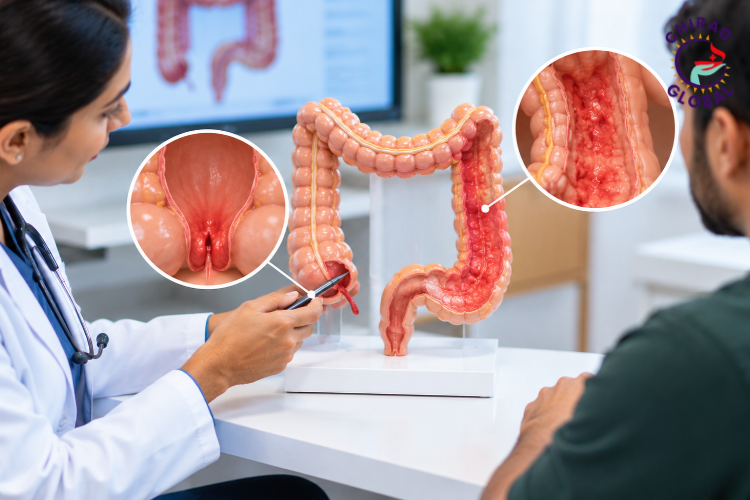
Ulcerative proctitis describes ulcerative inflammation limited to the rectum, which is the lower part of the large intestine. It is therefore a term that describes the location of the inflammation.
Common symptoms discussed with ulcerative proctitis
People may report:
- Rectal bleeding
- An urgent need to pass stool
- Frequent bowel movements
- Mucus with stool
- A feeling that the bowel has not completely emptied
- Rectal discomfort in some cases
These symptoms are not specific to ulcerative proctitis, so they cannot establish the diagnosis on their own.
What Is Ulcerative Colitis?
Ulcerative colitis is a broader term for ulcerative inflammation involving the colon. The extent can vary. It may be limited to the rectum or extend into other sections of the colon.
Ulcerative proctitis is therefore often discussed within the wider spectrum of ulcerative colitis.
Symptoms associated with ulcerative colitis
Depending on the area involved, symptoms may include:
- Loose or frequent stools
- Rectal bleeding
- Bowel urgency
- Abdominal discomfort
- Changes in usual bowel habits
- Fatigue or reduced appetite in some situations
These symptoms can also occur with other gastrointestinal conditions.
Ulcerative Proctitis vs Ulcerative Colitis: Key Differences
The easiest way to understand the difference is to focus on location and extent.
| Feature | Ulcerative Proctitis | Ulcerative Colitis |
| Main area involved | Rectum | Colon, with extent varying |
| Relationship | Rectum-limited ulcerative inflammation | Broader term covering different extents |
| Symptoms | Often centred around rectal and bowel-movement symptoms | Can include rectal and abdominal bowel symptoms |
| Extent | Limited to the rectum | May extend beyond the rectum |
| Assessment | May focus on the rectum and lower bowel | May assess a wider portion of the colon |
| Terminology | Describes limited location | Describes the wider condition and its extent |
The table is a quick guide; clinical assessment is needed to interpret individual findings.
How Does the Extent of Ulcerative Inflammation Matter?
Doctors may describe ulcerative conditions according to how far inflammation extends through the large bowel.
Proctitis
Inflammation limited to the rectum is described as ulcerative proctitis.
Proctosigmoiditis
When inflammation extends from the rectum into the sigmoid colon, the term proctosigmoiditis may be used.
Left-sided colitis
When inflammation extends through the left side of the colon, it may be described as left-sided ulcerative colitis.
Extensive colitis
When a larger portion of the colon is involved, terms such as extensive colitis or pancolitis may be used, depending on the findings.
These terms describe anatomical extent rather than an individual’s experience.
Ulcerative Proctitis vs Ulcerative Colitis Symptoms
A common search is “ulcerative proctitis vs ulcerative colitis symptoms”. The reason is simple: the symptoms can overlap.
Rectal bleeding, urgency and changes in bowel habits can occur when the rectum is involved. When inflammation extends farther into the colon, bowel frequency, abdominal symptoms and other changes may also be discussed.
An online symptom search cannot reliably identify the cause or extent of bowel inflammation.
Before an appointment, it can help to record:
- Bowel movement frequency
- Presence of blood or mucus
- Urgency
- Abdominal discomfort
- Changes from your normal bowel pattern
- How long symptoms have been present
How Are Ulcerative Proctitis and Ulcerative Colitis Assessed?
Assessment starts with the person’s symptoms and medical history. A clinician may then choose investigations based on the presentation.
Medical history and examination
The discussion may cover bowel frequency, bleeding, urgency, abdominal symptoms and how long the changes have been present.
Endoscopic assessment
An endoscopic examination allows a clinician to view the lining of the rectum and colon. Depending on the situation, the examination may focus on the lower bowel or assess a larger portion of the colon.
This helps establish the distribution of inflammation and provides information for interpreting the diagnosis.
Other investigations
Depending on the clinical situation, laboratory or stool-based investigations may also be considered. The choice depends on the clinical situation.
Is Ulcerative Proctitis the Same as Ulcerative Colitis?
Not exactly, but the terms are closely connected.
Ulcerative proctitis describes ulcerative inflammation confined to the rectum. Ulcerative colitis is the broader term used for ulcerative inflammation involving the colon, with the extent varying between individuals.
A report saying “ulcerative proctitis” is therefore giving information about location, while ulcerative colitis can include several anatomical patterns.
Is Ulcerative Proctitis Milder Than Ulcerative Colitis?
It is easy to assume that inflammation affecting a smaller area will always cause fewer symptoms. That conclusion is not reliable.
Ulcerative proctitis has a narrower anatomical extent because it is limited to the rectum. However, symptom frequency and severity can vary between individuals. The location alone does not tell you how a person will feel.
A specialist can interpret the extent alongside symptoms, examination findings and other relevant information.
CTA: If you have a report mentioning ulcerative proctitis or ulcerative colitis and want help understanding the terminology, contact Chirag Global Hospitals in Bangalore to discuss your concerns with a specialist.
Questions to Ask Your Specialist
If you have been told that you may have ulcerative proctitis or ulcerative colitis, consider asking:
- Where is the inflammation located?
- How much of the colon is involved?
- What did the examination or investigation show?
- Could another condition explain similar symptoms?
- What follow-up is appropriate?
- Which changes in symptoms should prompt an earlier review?
- When should the condition be reassessed?
A written list of questions and a short symptom record can make the consultation more focused.
Key Takeaways
The main difference between ulcerative proctitis and ulcerative colitis is the extent of the bowel involved.
Ulcerative proctitis refers to ulcerative inflammation limited to the rectum. Ulcerative colitis is the broader term used for ulcerative inflammation involving the colon, and the affected area can vary.
Symptoms such as rectal bleeding, urgency, loose stools or abdominal discomfort can overlap with other gastrointestinal conditions. They should therefore be interpreted alongside a clinical assessment rather than used alone to determine the diagnosis.
For people in Bangalore who want to discuss colorectal symptoms or understand a report, Chirag Global Hospitals can provide a setting for specialist consultation.
Looking for colorectal consultation in Bangalore? Connect with Chirag Global Hospitals to discuss persistent bowel symptoms, understand your report and determine an appropriate next step with a specialist.
Frequently Asked Questions
What is the main difference between ulcerative proctitis and ulcerative colitis?
The main difference is the extent of the bowel involved. Ulcerative proctitis is limited to the rectum, while ulcerative colitis can involve the rectum and extend into other parts of the colon.
Is ulcerative proctitis a type of ulcerative colitis?
Ulcerative proctitis is commonly described as a rectum-limited form within the spectrum of ulcerative colitis. The terminology indicates where the inflammation is located.
Can ulcerative proctitis cause rectal bleeding?
Rectal bleeding can occur with ulcerative proctitis, but it can also have other causes. The symptom should therefore be assessed rather than used alone to identify the condition.
What are the symptoms of ulcerative colitis?
Symptoms can include changes in bowel habits, bowel urgency, rectal bleeding, loose or frequent stools and abdominal discomfort. The pattern varies according to the individual and the extent of bowel involvement.
How is ulcerative proctitis assessed?
Assessment can include medical history, physical examination and appropriate investigations. Endoscopic examination may be used to view the rectum and colon and understand the distribution of inflammation.
Can ulcerative proctitis and ulcerative colitis have similar symptoms?
Yes. Urgency, rectal bleeding and bowel habit changes can overlap. This is why symptoms alone cannot reliably establish the exact condition or extent.
Which specialist should I see for ulcerative proctitis or ulcerative colitis?
A gastroenterology or colorectal specialist can assess symptoms involving the rectum and colon and determine what evaluation is appropriate.
When should I discuss bowel symptoms with a specialist?
Consider an assessment when bowel symptoms are persistent, recurrent, changing from your usual pattern or causing concern, particularly when rectal bleeding is present.