

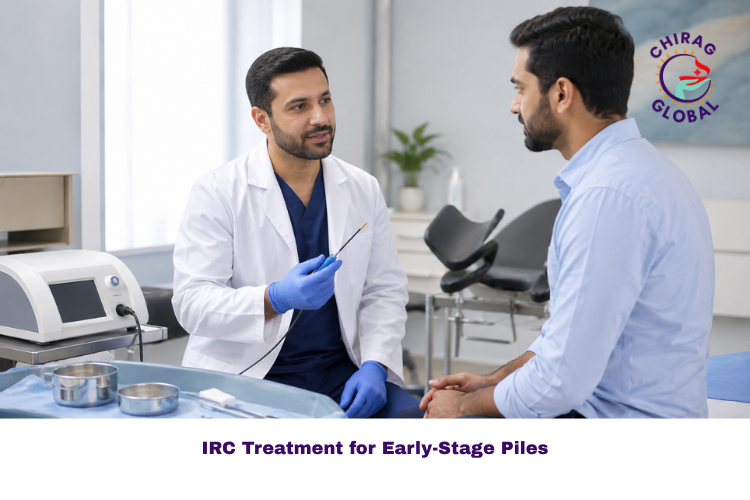
Infrared Coagulation (IRC) is a modern, minimally invasive procedure for treating early-stage piles, also known as hemorrhoids. For patients experiencing mild bleeding, itching, or discomfort during bowel movements, IRC offers a safe and effective alternative to traditional surgery, with less pain and faster recovery. At Chirag Global Hospitals, Bangalore, colorectal specialists use this technique to help patients find relief quickly while minimizing tissue trauma.
Book a Consultation | Call 08065903127
What Is IRC Treatment?
Infrared Coagulation (IRC) is a technique in which a specialized probe emits focused infrared light to coagulate the blood vessels supplying the hemorrhoidal tissue. This energy causes the hemorrhoid to shrink gradually, reducing symptoms without cutting or suturing tissue.
Why Infrared Coagulation (IRC) Is Effective
Unlike traditional surgery:
- It targets the hemorrhoid precisely, preserving surrounding tissue
- Seals blood vessels immediately, reducing intra-procedural bleeding
- Promotes natural absorption of hemorrhoidal tissue over 2–3 weeks
- Minimizes post-procedure pain and allows faster return to daily activities
IRC is particularly recommended for Grade I and II piles, which are not significantly prolapsed and have not caused complications such as thrombosis or severe bleeding.
How IRC Procedure Is Performed
- Patient Preparation
The anal area is cleaned, and local antiseptic is applied. Depending on the patient’s comfort, local anesthesia or light sedation may be used. - Infrared Application
The surgeon places the IRC probe at the base of the hemorrhoid. The infrared energy penetrates the tissue, coagulating veins and causing the hemorrhoid to shrink. - Immediate Results
Patients often notice reduced bleeding immediately. Over the next few weeks, the hemorrhoid tissue gradually shrinks, relieving swelling and discomfort. - Post-Procedure Observation
IRC is performed as an outpatient procedure, so most patients can leave the hospital the same day. Follow-up visits are scheduled to monitor healing and assess whether additional sessions are needed.
Benefits of IRC Treatment
IRC offers several advantages over traditional surgical treatment:
- Minimally Invasive: No cuts or stitches required
- Outpatient Procedure: No hospitalization needed
- Fast Recovery: Most patients resume normal activities the same day
- Minimal Pain: Less discomfort compared to conventional surgery
- Effective Symptom Relief: Reduces bleeding, itching, and swelling
- Repeatable: Can be repeated for multiple hemorrhoids if necessary
Because of these benefits, IRC has become a preferred treatment for early-stage piles for patients seeking quick, safe, and effective relief.
Who Is a Good Candidate For Infrared Coagulation Treatment?
IRC is ideal for patients with:
- Grade I or II hemorrhoids
- Mild bleeding or itching during bowel movements
- Slight prolapse or internal hemorrhoids that do not protrude significantly
- Desire for a minimally invasive, outpatient procedure
IRC is not suitable for:
- Grade III or IV hemorrhoids with severe prolapse
- Thrombosed or gangrenous piles
- Piles complicated by anal fissures or fistulas
- Patients with underlying colorectal malignancy or severe inflammatory bowel disease
A colorectal specialist evaluates each patient individually to ensure the procedure is appropriate.
Why IRC Is Safe and Reliable
IRC is considered safe because it:
- Does not cut surrounding tissue
- Minimizes intra-procedural bleeding
- Preserves anal function and sphincter integrity
- Reduces risk of infection
- Can be combined with dietary and lifestyle interventions for long-term relief
At Chirag Global Hospitals, experienced colorectal surgeons ensure that IRC is performed with precision and patient safety in mind.
Conclusion
Infrared Coagulation (IRC) is a minimally invasive, effective, and safe option for early-stage piles. It reduces bleeding, shrinks hemorrhoids, and provides symptom relief with minimal discomfort.
If you are experiencing mild bleeding, itching, or discomfort from early-stage hemorrhoids, IRC treatment at Chirag Global Hospitals, Bangalore may be the ideal choice. Early intervention can prevent progression and improve quality of life.
FAQs
1. What is the best treatment for early-stage piles in Bangalore?
Infrared Coagulation (IRC) is one of the safest and most effective treatments for Grade I and II piles in Bangalore. It minimizes bleeding, reduces pain, and allows quick recovery compared to conventional surgery.
2. How is IRC treatment performed at Chirag Global Hospitals, Bangalore?
IRC is performed as an outpatient procedure. A specialized probe delivers infrared light to the base of the hemorrhoid, coagulating blood vessels and causing the pile to shrink. The procedure is quick, precise, and minimally invasive.
3. How many sessions of IRC are required?
Most patients with one or two hemorrhoids may need a single session. Patients with multiple early-stage piles might require two or more sessions, spaced 2–3 weeks apart. Your colorectal specialist in Bangalore will assess and schedule accordingly.
4. How long does it take to recover from IRC treatment in Bangalore?
Recovery is usually rapid. Patients can resume daily activities immediately, with full hemorrhoid shrinkage and symptom relief typically within 2–3 weeks. Minimal post-procedure discomfort is expected.
5. Can IRC treatment prevent the progression of piles?
Yes. IRC reduces bleeding, swelling, and discomfort in early-stage piles. When combined with dietary and lifestyle changes advised by the Bangalore colorectal team, IRC helps prevent worsening and progression to advanced stages.
6. Is IRC suitable for all types of piles?
IRC is most effective for early-stage internal hemorrhoids (Grades I and II). Advanced piles (Grade III or IV), thrombosed hemorrhoids, or complicated cases may require alternative procedures like laser treatment or minimally invasive surgery.
7. Are there any side effects or risks of IRC?
Side effects are minimal, typically including mild discomfort, temporary spotting, or itching. Serious complications are rare when IRC is performed by experienced colorectal specialists.