
Can you have piles and fissure together? Yes. Although piles and anal fissures are different conditions, they can occur at the same time.
Both conditions can be associated with constipation, hard stools, repeated straining, and changes in bowel habits. Because they can cause overlapping symptoms such as bleeding, pain, itching, and discomfort, it is sometimes difficult to know which condition is responsible.
Understanding the difference between piles and fissure is important because their treatments can be different.
At Chirag Global Hospitals, patients with anal pain, rectal bleeding, or an anal lump can be evaluated to determine whether they have piles, an anal fissure, both conditions, or another anorectal problem.
Book a Consultation | Call 08065903127
Can You Have Piles and Fissure at the Same Time?
Yes, piles and fissure can occur together.
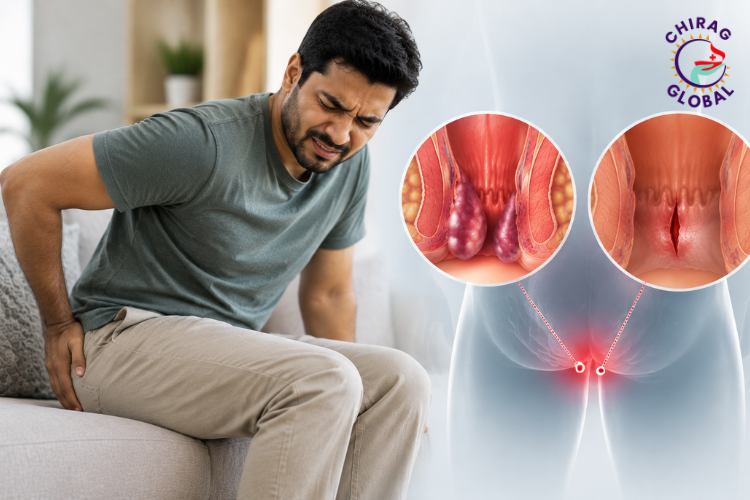
An anal fissure is a tear in the tissue around the anus, while piles, medically known as hemorrhoids, are swollen blood vessels in the lower rectum or anus.
The two conditions do not necessarily cause each other directly. Instead, they may develop because of common contributing factors such as:
- Constipation
- Hard stools
- Repeated straining
- Irregular bowel habits
- Frequent diarrhea
- Prolonged sitting on the toilet
- Changes in bowel movements
For example, a person with constipation may develop an anal fissure from passing a hard stool while also experiencing hemorrhoid symptoms from repeated straining.
What Are Piles?
Piles, or hemorrhoids, are swollen and enlarged blood vessels and supporting tissues in the lower rectum and anus.
They are generally classified into two types.
Internal Hemorrhoids
Internal hemorrhoids develop inside the rectum.
They commonly cause:
- Bright-red rectal bleeding
- A feeling of incomplete bowel emptying
- Prolapse in more advanced cases
- Mild discomfort or irritation
Internal hemorrhoids may not always cause significant pain.
External Hemorrhoids
External hemorrhoids develop under the skin around the anus.
They may cause:
- An anal lump
- Swelling
- Itching
- Tenderness
- Pain
A blood clot can sometimes form inside an external hemorrhoid, resulting in a painful condition known as a thrombosed external hemorrhoid.
What Is an Anal Fissure?
An anal fissure is a small tear in the lining or skin around the anus.
It commonly develops when a hard or large stool stretches and injures the anal tissue. Fissures can also occur with repeated diarrhea or other forms of local irritation.
Typical symptoms include:
- Sharp pain while passing stool
- Burning or pain after a bowel movement
- Bright-red bleeding
- Anal discomfort
- A visible tear in some cases
- A small skin tag near a chronic fissure
Pain from an anal fissure can sometimes continue for minutes or hours after passing stool.
Why Can Piles and Fissure Occur Together?
Piles and fissures can coexist because they share several risk factors.
Constipation
Constipation can result in hard, dry stools that are difficult to pass.
Passing hard stool can injure the anal tissue and contribute to a fissure. Repeated straining associated with constipation can also contribute to hemorrhoid symptoms.
Straining During Bowel Movements
Repeatedly pushing hard during bowel movements increases pressure in the anal and rectal area.
If this becomes a regular habit, it can contribute to hemorrhoidal symptoms and may worsen an existing fissure.
Irregular Bowel Habits
Frequent diarrhea can irritate the anal area, while alternating constipation and diarrhea can repeatedly traumatize the tissue.
These bowel changes may make existing piles or fissure symptoms more noticeable.
Delaying Bowel Movements
Regularly ignoring the urge to pass stool can contribute to constipation in some people.
A cycle can develop:
Hard stool → pain → avoiding bowel movements → stool retention → harder stool → more pain
Breaking this cycle is an important part of managing both conditions.
Piles and Fissure: What Is the Difference?
Although piles and fissures can occur together, they affect different tissues and often produce different symptoms.
| Symptom | Piles | Anal Fissure |
| Bright-red bleeding | Common | Can occur |
| Sharp pain during bowel movement | Less typical, depending on type | Common |
| Burning pain after bowel movement | Possible | Common |
| Anal lump | Common with external hemorrhoids | Possible skin tag with chronic fissure |
| Itching | Common | Possible |
| Swelling | Possible | Possible |
| Pain after bowel movement | Possible | Often prominent |
| Association with hard stools | Can contribute | Common trigger |
These patterns are general and cannot confirm a diagnosis by themselves.
What Does Fissure Pain Feel Like?
Anal fissure pain is often described as:
- Sharp
- Cutting
- Tearing
- Burning
The pain typically occurs during bowel movements and may continue afterward.
Some people begin avoiding bowel movements because they are afraid of the pain. This can worsen constipation and create a cycle that makes the fissure harder to heal.
What Does Piles Pain Feel Like?
The type of pain associated with piles can vary.
Hemorrhoids may cause:
- Pressure
- Tenderness
- Itching
- Swelling
- Discomfort while sitting
A thrombosed external hemorrhoid can cause sudden and significant pain because of a blood clot within the hemorrhoid.
Can Both Piles and Fissure Cause Bleeding?
Yes.
Both piles and anal fissures can cause bright-red bleeding, particularly during or immediately after bowel movements.
However, rectal bleeding should not automatically be attributed to piles or fissure.
Bleeding can also occur with other gastrointestinal and colorectal conditions.
Medical evaluation is particularly important when bleeding is:
- Recurrent
- Heavy
- Unexplained
- Associated with changes in bowel habits
- Associated with abdominal pain
- Associated with unexplained weight loss
- Occurring in someone with relevant risk factors
Can Piles Cause a Fissure?
Piles do not directly cause an anal fissure.
However, a person with hemorrhoids may also experience constipation, straining, or difficult bowel movements. These factors can contribute to the development of a fissure.
Therefore, the two conditions may occur together without one directly causing the other.
Can a Fissure Cause Piles?
An anal fissure does not directly cause hemorrhoids.
However, the underlying bowel problems associated with the fissure, such as constipation and repeated straining, can also contribute to hemorrhoidal symptoms.
In some cases, both conditions develop from the same bowel habit rather than one condition causing the other.
How Are Piles and Fissure Diagnosed?
Diagnosis usually begins with a detailed discussion about symptoms and bowel habits.
A healthcare professional may ask about:
- Pain during bowel movements
- Pain after bowel movements
- Rectal bleeding
- Stool consistency
- Constipation
- Straining
- Itching
- Swelling
- Anal lumps
- Changes in bowel habits
- Previous episodes
- Previous treatments
A physical examination can help identify external hemorrhoids, fissures, skin tags, or other abnormalities.
Depending on age, symptoms, medical history, and examination findings, additional evaluation may sometimes be recommended.
Why Is Self-Diagnosis Difficult?
It is easy to assume:
Bleeding = piles
or:
Severe pain = fissure
But symptoms can overlap.
For example:
- Hemorrhoids can sometimes be painful.
- Fissures can cause bleeding.
- Thrombosed external hemorrhoids can cause severe pain and a lump.
- Other anorectal conditions can cause bleeding, pain, swelling, or discharge.
Therefore, persistent or recurring symptoms should be assessed rather than repeatedly treated based on assumptions.
How Are Piles and Fissure Treated Together?
Treatment depends on the type and severity of each condition.
When both piles and fissure are present, treatment may need to address both problems as well as the bowel habits contributing to them.
Improve Stool Consistency
Making bowel movements easier can reduce repeated trauma to the anal area.
Depending on individual needs, a healthcare professional may recommend:
- Gradually increasing dietary fiber
- Drinking adequate fluids
- Avoiding excessive straining
- Establishing a regular toilet routine
- Treating constipation appropriately
- Using stool-softening medicines when medically appropriate
Reduce Anal Irritation
Gentle anal hygiene can help reduce irritation.
Patients may be advised to:
- Keep the area clean
- Avoid excessive wiping
- Avoid harsh soaps or irritating products
- Avoid prolonged toilet sitting
- Avoid repeatedly straining to pass stool
Treat the Fissure
Some anal fissures improve with conservative treatment and correction of the underlying bowel problem.
For persistent fissures, a doctor may prescribe medications that help relax the anal sphincter and support healing.
Chronic fissures that do not respond adequately to medical treatment may require a procedure.
Treat the Hemorrhoids
Hemorrhoid treatment depends on the type and severity.
Treatment may range from:
- Dietary and lifestyle changes
- Constipation management
- Medicines
- Local treatments
- Office-based procedures
- Surgical treatment in selected cases
The appropriate treatment should be determined after examination.
Does Treating Constipation Help Both Piles and Fissure?
Addressing constipation can be an important part of managing both conditions.
When stools become easier to pass:
- Less straining may be needed.
- The fissure experiences less repeated trauma.
- Bowel movements may become less painful.
- Pressure associated with straining may be reduced.
- Stool holding may become less likely.
However, constipation management does not necessarily resolve every case of hemorrhoids or chronic anal fissure.
Persistent symptoms may require condition-specific treatment.
Can an Anal Fissure Become Chronic?
Yes.
Some acute fissures heal when constipation and other contributing factors are addressed.
However, a fissure that does not heal or repeatedly returns may become chronic.
Chronic fissures may be associated with changes in the surrounding tissue, including a skin tag or thickened tissue.
Persistent fissure symptoms should be assessed rather than repeatedly treated at home without identifying why healing is not occurring.
What Happens If You Treat Only the Piles?
If both conditions are present but only the hemorrhoids are treated, fissure-related pain may continue.
Similarly, treating only the fissure may not resolve significant hemorrhoidal symptoms.
This is why accurate diagnosis is important.
The objective is not simply to treat the most visible symptom. It is to identify all conditions contributing to the patient’s discomfort, bleeding, or bowel difficulties.
Can Piles and Fissure Heal Without Surgery?
Yes, many cases can initially be managed without surgery.
Depending on the condition, treatment may include:
- Dietary fiber
- Adequate fluid intake
- Constipation management
- Avoiding straining
- Appropriate medicines
- Local care
- Changes in toilet habits
Some hemorrhoids and anal fissures improve with conservative treatment.
However, persistent, recurrent, or severe disease may require an office-based procedure or surgery.
When Might a Procedure Be Needed?
A procedure may be considered when symptoms are:
- Severe
- Persistent
- Recurrent
- Affecting daily activities
- Not improving with conservative treatment
Treatment depends on the specific diagnosis.
For hemorrhoids, procedures vary according to the type and severity of the hemorrhoid.
For chronic anal fissures, targeted medical or surgical procedures may be considered when appropriate.
When both conditions occur together, the treatment plan should address each condition individually.
How Can You Reduce the Risk of Recurrence?
Piles and fissures cannot always be completely prevented from returning, but healthy bowel habits can reduce some contributing factors.
Keep Stools Soft
Eat a balanced diet containing adequate fiber and maintain appropriate fluid intake.
Avoid Straining
Allow bowel movements to occur naturally rather than repeatedly forcing stool out.
Do Not Ignore the Urge to Pass Stool
Regularly delaying bowel movements may contribute to constipation.
Avoid Prolonged Toilet Sitting
Spending unnecessary time sitting on the toilet can increase pressure around the anal area.
Stay Physically Active
Regular physical activity can support general bowel health and help maintain a healthy routine.
Address Recurring Constipation
If constipation keeps returning despite lifestyle changes, discuss it with a healthcare professional rather than repeatedly self-treating.
When Should You See a Doctor?
Consider medical evaluation if you experience:
- Repeated rectal bleeding
- Severe anal pain
- Pain that continues after bowel movements
- A new or painful anal lump
- Recurrent fissures
- Persistent constipation
- Symptoms lasting several weeks
- Symptoms that repeatedly return
- Unexplained changes in bowel habits
Do not assume that recurring rectal bleeding is caused by piles or fissure without appropriate evaluation.
When Is Urgent Medical Attention Needed?
Seek urgent medical attention for symptoms such as:
- Heavy or ongoing rectal bleeding
- Fainting or significant weakness associated with bleeding
- Severe or rapidly worsening pain
- Fever with significant anal pain or swelling
- Pus or significant discharge
- Severe abdominal pain
- Other signs of serious illness
Prompt evaluation is particularly important when symptoms are sudden, severe, or worsening.
Piles and Fissure Treatment at Chirag Global Hospitals
At Chirag Global Hospitals, patients with symptoms such as anal pain, rectal bleeding, swelling, or an anal lump can undergo appropriate evaluation for hemorrhoids, anal fissures, and other colorectal conditions.
When piles and fissure occur together, identifying each condition is important because the treatment approach may differ.
A specialist assessment can help determine whether the symptoms are caused by piles, an anal fissure, both conditions, or another anorectal problem.
Treatment can then be planned according to the individual’s symptoms, examination findings, and overall health.
Conclusion
Piles and fissure can occur together, but they are two different conditions.
Piles involve swollen hemorrhoidal blood vessels and supporting tissues, while an anal fissure is a tear in the tissue around the anus. Both can be associated with constipation, hard stools, and repeated straining, which is why they may appear at the same time.
Because symptoms can overlap, it is not always possible to identify the problem based on bleeding or pain alone.
If you experience persistent anal pain, rectal bleeding, a lump, recurrent constipation, or symptoms that keep returning, seek appropriate medical evaluation. An accurate diagnosis is the first step toward choosing the right treatment.
Visit Chirag Global Hospitals Today!
Frequently Asked Questions
Can you have piles and fissure at the same time?
Yes. Piles and fissure can occur together, particularly when constipation, hard stools, and repeated straining contribute to both conditions.
How can I tell the difference between piles and fissure?
An anal fissure commonly causes sharp or burning pain during and after bowel movements. Hemorrhoids may cause bleeding, itching, swelling, or a lump. Because symptoms can overlap, examination may be necessary.
Can constipation cause both piles and fissure?
Yes. Hard stools can injure the anal tissue and contribute to a fissure, while constipation and straining can also contribute to hemorrhoids.
Which is more painful, piles or fissure?
Anal fissures commonly cause sharp or burning pain during and after bowel movements. However, a thrombosed external hemorrhoid can also cause significant pain.
Can piles and fissure heal together?
Yes. Both conditions may improve when constipation and straining are addressed and appropriate treatment is provided. The recovery period varies depending on the severity and type of each condition.
Can piles and fissure both cause bleeding?
Yes. Both conditions can cause bright-red rectal bleeding. However, recurrent or unexplained bleeding should be medically evaluated because there are other possible causes.
Can I treat piles and fissure at home?
Some mild symptoms may improve with adequate fiber and fluids, constipation management, and avoiding straining. Persistent pain, recurrent bleeding, or uncertain symptoms should be evaluated by a healthcare professional.
Do piles and fissure always require surgery?
No. Many cases can initially be treated without surgery. A procedure or surgery may be considered when symptoms are severe, persistent, recurrent, or do not respond adequately to conservative treatment.
Can treating constipation help a fissure heal?
Addressing constipation can reduce repeated trauma from hard stools and make bowel movements easier. However, chronic fissures may require additional treatment.
Can a fissure return after treatment?
Yes. Fissures can recur, particularly if constipation, hard stools, diarrhea, or repeated straining continues. Maintaining healthy bowel habits can help reduce some risk factors.
Can piles return after treatment?
Yes. Hemorrhoids can recur, especially when contributing factors such as constipation and straining continue. Long-term bowel-habit changes can help reduce recurrence risk.