
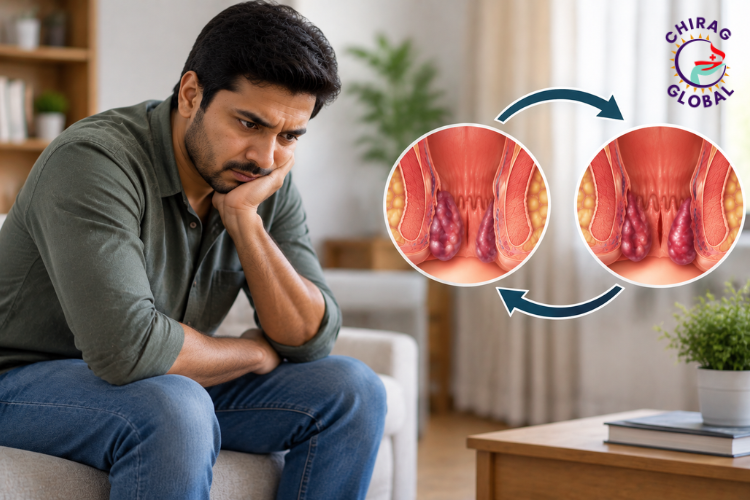
Having piles treated can bring significant relief, but some people notice bleeding, swelling, discomfort, or prolapse again months or years later. This can lead to an understandable question: Why do piles come back after treatment?
Piles recurrence can happen for several reasons. Treatment may have addressed the symptomatic hemorrhoids at that time, but factors such as chronic constipation, straining, prolonged toilet sitting, low fiber intake, or ongoing bowel-habit problems may continue to place pressure on the anorectal area. In some cases, new or previously less troublesome hemorrhoidal tissue can also become symptomatic.
At Chirag Global Hospitals, recurrent piles can be evaluated to determine whether the symptoms represent recurrent hemorrhoids, another anorectal condition, or a bowel-habit problem that needs attention.
Book a Consultation | Call 08065903127
What Does Piles Recurrence Mean?
Piles, medically known as hemorrhoids, are swollen vascular structures in and around the anus and lower rectum.
Piles recurrence generally refers to hemorrhoid symptoms returning after they had previously improved following treatment.
The symptoms may include:
- Bright-red bleeding during or after bowel movements
- A lump around the anus
- Protrusion during bowel movements
- Anal itching
- Pain or discomfort
- Swelling
- A feeling of incomplete emptying
The symptoms can vary depending on whether the hemorrhoids are internal or external. Internal hemorrhoids commonly cause bleeding or prolapse, while external hemorrhoids may cause a tender lump, itching, or discomfort.
However, not every episode of rectal bleeding or anal discomfort means that piles have returned. Other conditions can cause similar symptoms, which is why recurrent symptoms should not automatically be self-diagnosed as hemorrhoids.
Why Do Piles Come Back After Treatment?
1. The Factors That Caused Piles May Still Be Present
One of the most important reasons hemorrhoid symptoms can return is that the underlying contributing factors have not changed.
For example, someone may receive treatment for piles but continue to experience:
- Chronic constipation
- Hard stools
- Frequent straining
- Long periods sitting on the toilet
- Low dietary fiber
- Repeated diarrhea
- Heavy lifting
- Irregular bowel habits
These factors are associated with hemorrhoids and may continue to place pressure on the tissues around the anus.
Treatment can address the hemorrhoids, but long-term prevention also involves addressing the bowel habits that contribute to symptoms.
2. Constipation Can Trigger Recurrent Symptoms
Constipation is one of the most common factors to consider when piles repeatedly return.
Hard stools can require more effort to pass, while repeated straining increases pressure in the anorectal region.
If constipation continues after piles treatment, the same cycle can develop again:
Hard stool → straining → increased pressure → hemorrhoid symptoms
For this reason, managing constipation is an important part of reducing the likelihood of future hemorrhoid problems.
3. Straining During Bowel Movements May Continue
Some people automatically strain when they sit on the toilet, particularly when they feel that their bowel movement is incomplete.
Repeated or excessive straining can contribute to hemorrhoid symptoms.
Instead of forcing a bowel movement, it is better to establish healthy bowel habits and address the reason stools are difficult to pass.
4. Spending Too Long on the Toilet
Toilet habits can be easy to overlook after treatment.
Some people spend extended periods sitting on the toilet while reading, watching videos, or using their phone. Prolonged toilet sitting is recognized as a contributing factor for hemorrhoids.
Therefore, even after successful treatment, returning to prolonged toilet sitting may contribute to future symptoms.
5. Fiber Intake May Drop Again
A person may increase fiber while recovering from piles but return to a low-fiber diet once symptoms improve.
Fiber helps make stools softer and easier to pass and can help reduce the need for straining. NIDDK notes that adults generally need around 22–34 grams of fiber per day, depending on age and sex. Fiber should generally be increased gradually.
Good sources include:
- Fruits
- Vegetables
- Whole grains
- Beans and lentils
- Nuts
- Seeds
The appropriate amount can vary between individuals, particularly for people with specific digestive conditions.
6. Inadequate Fluid Intake Can Affect Stool Consistency
Fiber works better when adequate fluids are consumed.
If someone increases fiber but does not consume enough fluids, they may not get the expected improvement in stool consistency.
NIDDK recommends drinking water and other liquids to help fiber work more effectively, while individual fluid requirements depend on factors such as health and activity level.
7. The Original Treatment May Not Have Addressed Every Hemorrhoid
Hemorrhoids can involve multiple vascular cushions, and symptoms can vary over time.
Some treatments are directed at specific symptomatic hemorrhoids rather than eliminating every hemorrhoidal structure.
For example, rubber band ligation may need to be repeated depending on the size of the hemorrhoids or if they return.
Therefore, experiencing symptoms again does not automatically mean that the original treatment was unsuccessful.
8. A Different Hemorrhoid May Become Symptomatic
Another possibility is that the original problem improved but a different hemorrhoidal area later becomes symptomatic.
This is one reason a new episode of bleeding, swelling, or prolapse should be evaluated rather than assuming that the exact same hemorrhoid has returned.
Does Piles Surgery Guarantee That Piles Will Never Come Back?
No treatment should be considered a permanent guarantee against future hemorrhoid symptoms.
Different procedures treat hemorrhoids in different ways, and recurrence rates can vary according to the procedure, hemorrhoid type, severity, patient factors, and follow-up period.
The 2024 American Society of Colon and Rectal Surgeons clinical practice guideline emphasizes that hemorrhoid treatment should be selected according to the patient’s symptoms, anatomy, and clinical circumstances.
Even after a procedure, maintaining healthy bowel and toilet habits remains important.
How Can You Reduce the Risk of Piles Recurrence?
Preventing recurrence is not about avoiding every activity or food. It is mainly about reducing repeated pressure and straining during bowel movements.
Keep Stools Soft and Easy to Pass
A fiber-rich diet can help improve stool consistency.
Gradually include foods such as vegetables, fruits, whole grains, legumes, nuts, and seeds.
Drink Adequate Fluids
Adequate fluid intake supports the effects of dietary fiber and can help prevent hard stools.
Your fluid requirement should be individualized according to your health, activity level, climate, and other factors.
Avoid Excessive Straining
Try not to force stool out when it does not pass easily.
If bowel movements consistently require significant straining, the underlying constipation should be addressed rather than simply continuing to push harder.
Keep Toilet Time Short
Avoid sitting on the toilet for unnecessarily long periods.
Leaving your phone outside the bathroom can be a simple way to prevent prolonged toilet sitting.
Stay Physically Active
Regular physical activity can support bowel function and help reduce constipation. NIDDK includes regular physical activity among measures that can help with hemorrhoid management and prevention.
Respond to the Urge to Pass Stool
Repeatedly ignoring the urge to have a bowel movement can interfere with healthy bowel habits.
Try to maintain a consistent routine rather than repeatedly delaying bowel movements because of work, travel, or other activities.
What If Piles Return After Surgery?
If symptoms return after hemorrhoid surgery, do not immediately assume that another surgery is necessary.
A doctor may first determine:
- Whether hemorrhoids are actually responsible for the symptoms
- Whether the problem is internal, external, or both
- Whether constipation or straining is contributing
- Whether there is prolapse
- Whether another anorectal condition could explain the symptoms
- What treatment was performed previously
- Whether the current symptoms require conservative treatment, an office procedure, or another intervention
The appropriate approach depends on the findings.
Some recurrent symptoms can be managed with bowel and lifestyle changes, while persistent or significant hemorrhoids may require procedural treatment.
Can Recurrent Piles Be Treated Without Surgery?
Sometimes.
The treatment depends on the severity and type of hemorrhoids.
For mild symptoms, doctors may recommend measures such as:
- Increasing dietary fiber
- Maintaining adequate fluid intake
- Avoiding straining
- Limiting toilet time
- Increasing physical activity
- Treating constipation
When symptoms continue, office-based treatments such as rubber band ligation, sclerotherapy, infrared photocoagulation, or electrocoagulation may be considered for appropriate internal hemorrhoids. More advanced or persistent hemorrhoids may require a surgical approach.
The key is to choose treatment based on the current condition rather than assuming the same procedure used previously is automatically required again.
When Should You See a Doctor for Piles Recurrence?
Recurring symptoms deserve attention, particularly if they are becoming more frequent or severe.
See a doctor if you experience:
- Repeated rectal bleeding
- Persistent anal pain
- Recurrent lumps around the anus
- Increasing swelling
- Hemorrhoids that repeatedly protrude
- Symptoms that do not improve with appropriate home measures
- A significant change in bowel habits
- Unexplained weight loss
NIDDK advises seeking medical attention for rectal bleeding and for hemorrhoid symptoms that do not improve after a period of home treatment.
Severe anal pain accompanied by rectal bleeding, particularly with abdominal discomfort, diarrhea, or fever, requires prompt medical attention.
Is Every Recurrence Really Piles?
No.
This is particularly important when bleeding is the main symptom.
Rectal bleeding can occur with hemorrhoids, but it can also occur with other digestive or colorectal conditions. NIDDK notes that some bowel diseases can produce symptoms similar to hemorrhoids.
Therefore, repeated bleeding should not simply be treated as “piles coming back” without appropriate assessment.
A proper examination can help determine whether hemorrhoids are responsible and whether another condition needs to be investigated.
Conclusion
Piles recurrence does not always mean that previous treatment failed.
Hemorrhoid symptoms can return when factors such as constipation, hard stools, straining, prolonged toilet sitting, low fiber intake, or unhealthy bowel habits continue. In some cases, another hemorrhoidal area may become symptomatic later.
The best approach is therefore not simply to repeat the previous treatment. First, determine why the symptoms have returned and whether the current problem is actually caused by hemorrhoids.
Maintaining adequate fiber and fluids, staying physically active, avoiding excessive straining, and keeping toilet time short can help reduce factors associated with hemorrhoids.
If bleeding, pain, swelling, or prolapse keeps returning, consult a colorectal or proctology specialist for an appropriate evaluation.
At Chirag Global Hospitals, recurrent piles can be assessed based on the current symptoms, previous treatment, bowel habits, and severity of the hemorrhoids so that the next treatment decision is based on the underlying problem.
Visit Chirag Global Hospitals Today!
Frequently Asked Questions
Why Do Piles Come Back After Treatment?
Piles may return because contributing factors such as constipation, straining, prolonged toilet sitting, low fiber intake, or other bowel-habit problems continue. Sometimes a different hemorrhoidal area may become symptomatic later.
Can Constipation Cause Piles to Come Back?
Constipation can contribute to hemorrhoid symptoms because hard stools and straining increase pressure around the anus and lower rectum. Managing constipation is therefore an important part of reducing recurrence.
Can Piles Come Back After Surgery?
Yes. Hemorrhoid symptoms can recur after treatment. Recurrence does not necessarily mean that the original procedure failed. The cause and current severity should be assessed before deciding on further treatment.
How Can I Prevent Piles From Coming Back?
Focus on keeping stools soft, eating adequate fiber, drinking appropriate amounts of fluid, exercising regularly, avoiding excessive straining, responding to the urge to pass stool, and avoiding prolonged sitting on the toilet.
Is It Normal to Have Bleeding Again After Piles Treatment?
Bleeding should not automatically be considered normal simply because you have a history of piles. Recurrent or persistent rectal bleeding should be evaluated because several conditions can cause it.
Do Recurrent Piles Always Need Another Surgery?
No. Treatment depends on the type and severity of the hemorrhoids and the symptoms. Some cases can be managed with lifestyle and bowel-habit changes, while others may require an office procedure or surgery.
When Should I See a Piles Specialist?
If piles repeatedly return, cause frequent bleeding or prolapse, remain painful, or do not improve with appropriate self-care, a colorectal or proctology evaluation can help identify the cause and determine the appropriate treatment.