
A diagnosis of colon cancer can raise many questions, and one of the first is often: “What stage is the cancer?” Colon cancer staging helps doctors understand how far the cancer has developed and whether it has spread beyond the original tumour.
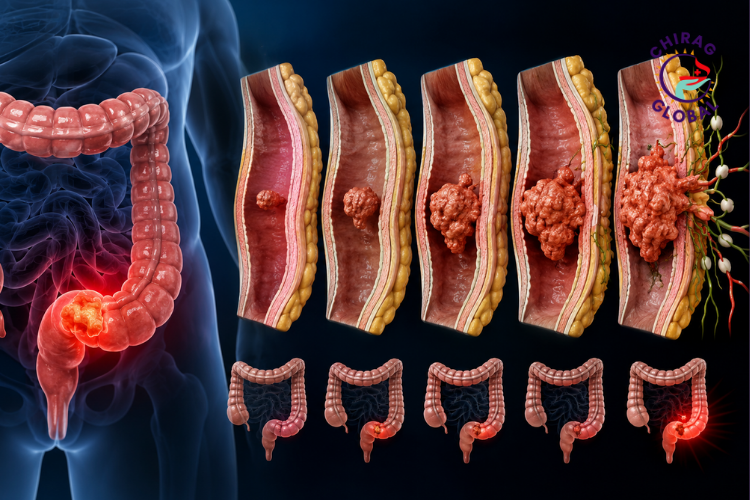
The colon cancer stages range from Stage 0 to Stage 4. Earlier stages generally mean that the cancer is confined to the inner layers or wall of the colon, while advanced stages indicate that it has spread to nearby lymph nodes or distant organs.
Staging is not based on tumour size alone. Doctors consider how deeply the cancer has grown into the bowel wall, whether nearby lymph nodes contain cancer cells, and whether the disease has spread to distant parts of the body.
At Chirag Global Hospitals, Bangalore, patients diagnosed with colon cancer can undergo appropriate evaluation to determine the stage and develop an individualized treatment plan based on the cancer’s characteristics and overall health.
Book a Consultation | Call 08065903127
What Does Colon Cancer Staging Mean?
Colon cancer staging describes the extent of cancer in the body at the time it is diagnosed.
Doctors primarily use the TNM system:
- T (Tumour): How deeply the primary tumour has grown through the colon wall.
- N (Nodes): Whether cancer has spread to nearby lymph nodes.
- M (Metastasis): Whether cancer has spread to distant organs or tissues.
These findings are combined to determine the overall stage.
The stage helps doctors discuss:
- How advanced the cancer is
- Whether surgery may be appropriate
- Whether chemotherapy or other treatments may be needed
- The likelihood of recurrence
- Follow-up requirements
Importantly, stage is only one factor that influences prognosis and treatment.
What Are the Stages of Colon Cancer?
Colon cancer is commonly grouped into:
- Stage 0
- Stage 1
- Stage 2
- Stage 3
- Stage 4
Each stage represents a different extent of disease.
Stage 0 Colon Cancer
Stage 0 is sometimes called carcinoma in situ.
At this stage, abnormal cancerous cells are limited to the innermost lining of the colon and have not grown deeply into the bowel wall.
Because the disease is very localized, treatment may involve removing the abnormal tissue or lesion.
Stage 0 is different from invasive colon cancer because the abnormal cells have not invaded deeper layers.
Stage 1 Colon Cancer
In Stage 1 colon cancer, the cancer has grown beyond the innermost lining and into deeper layers of the colon wall.
However, it has not spread to nearby lymph nodes or distant organs.
Treatment commonly centres on surgical removal of the affected section of the colon, depending on the tumour’s location and other clinical factors.
Additional treatment may not be necessary for every patient with Stage 1 disease.
Stage 2 Colon Cancer
Stage 2 colon cancer has grown further through the wall of the colon but has not spread to nearby lymph nodes or distant organs.
Stage 2 is divided into subcategories, including:
- Stage 2A
- Stage 2B
- Stage 2C
These distinctions are based largely on how deeply the tumour has grown and whether it has extended into or through nearby structures.
Some Stage 2 cancers have a higher risk of recurrence than others.
Doctors may therefore examine additional features of the tumour when deciding whether chemotherapy after surgery could provide a benefit.
Stage 3 Colon Cancer
In Stage 3 colon cancer, the cancer has spread to nearby lymph nodes.
The exact extent of lymph-node involvement and depth of tumour invasion determines the specific Stage 3 category.
Stage 3 is commonly divided into:
- Stage 3A
- Stage 3B
- Stage 3C
The cancer has not spread to distant organs in Stage 3.
Treatment often involves surgery followed by chemotherapy, although the exact treatment plan depends on the individual’s cancer and overall health.
Stage 4 Colon Cancer
Stage 4 colon cancer means the cancer has spread to distant parts of the body.
This is called metastatic colon cancer.
Common sites of distant spread include:
- Liver
- Lungs
- Peritoneum
- Other distant tissues or organs
Stage 4 can be further classified based on where and how extensively the cancer has spread.
Treatment may involve a combination of approaches, such as:
- Chemotherapy
- Targeted therapy
- Immunotherapy for selected tumours
- Surgery in carefully selected situations
- Ablation or other local treatments in selected patients
- Supportive and palliative care
Stage 4 does not mean that treatment is no longer possible. Some patients with limited metastatic disease may be candidates for treatments intended to control or, in selected circumstances, remove all detectable disease.
Colon Cancer Stages at a Glance
| Stage | General Meaning | Typical Treatment Approach |
| Stage 0 | Abnormal cells limited to the innermost lining | Removal of the lesion or local treatment |
| Stage 1 | Cancer has invaded the bowel wall but has not reached lymph nodes | Usually surgery |
| Stage 2 | Cancer has grown through the colon wall without lymph-node spread | Surgery; chemotherapy considered for selected higher-risk cases |
| Stage 3 | Cancer has spread to nearby lymph nodes | Surgery plus chemotherapy in many cases |
| Stage 4 | Cancer has spread to distant organs | Systemic therapy, with surgery or other treatments for selected patients |
This table provides a simplified overview. Individual treatment can vary considerably.
Can Colon Cancer Be Cured?
The possibility of cure depends on several factors, including the stage and biological characteristics of the cancer.
Localized colon cancer, particularly when detected early and completely removed, may be treated with curative intent.
Some patients with metastatic disease can also undergo treatment intended to eliminate all detectable cancer, particularly when the number and location of metastases make this feasible.
For other Stage 4 cancers, treatment may focus on controlling the disease, extending survival, relieving symptoms, and maintaining quality of life.
Therefore, the stage provides important information, but it cannot by itself predict exactly what will happen to an individual patient.
What Happens After Colon Cancer Staging?
Once staging is complete, the medical team discusses the treatment strategy.
Depending on the stage, this may involve:
Surgery
Surgery is an important treatment for many localized colon cancers.
The affected portion of the colon and nearby lymph nodes may be removed.
Chemotherapy
Chemotherapy may be recommended after surgery for many Stage 3 cancers and selected Stage 2 cancers. It can also be used for metastatic disease.
Targeted Therapy
Certain advanced colon cancers may respond to medicines that target specific molecular features of the tumour.
Immunotherapy
Some colon cancers have biological characteristics that make them suitable for immunotherapy.
Follow-Up
After treatment, regular follow-up helps monitor for recurrence and manage long-term health.
Colon Cancer Staging and Treatment at Chirag Global Hospitals, Bangalore
At Chirag Global Hospitals, Bangalore, patients with suspected or confirmed colon cancer can undergo appropriate diagnostic evaluation and staging.
Understanding the stage is an important part of developing a treatment plan. The medical team can assess the tumour, lymph-node involvement, possible distant spread, and other relevant clinical factors before discussing treatment options.
For patients who have already received a diagnosis, discussing the staging results with the treating specialist can help clarify what the findings mean and what the next steps may involve.
Conclusion
Understanding colon cancer stages helps explain how far the disease has progressed and assists doctors in planning treatment. Stage 0 and Stage 1 generally represent very localized disease, while Stage 2 involves deeper invasion without lymph-node spread. Stage 3 indicates nearby lymph-node involvement, and Stage 4 means the cancer has spread to distant parts of the body.
However, stage is not the only factor that determines treatment or prognosis. Tumour biology, molecular characteristics, overall health, response to treatment, and the location and extent of disease can all influence medical decisions.
If you have been diagnosed with colon cancer, discussing the exact TNM findings and stage with your specialist can provide a clearer understanding of your treatment options and next steps.
Visit Chirag Global Hospitals Today!
Frequently Asked Questions
How many stages of colon cancer are there?
Colon cancer is generally classified from Stage 0 through Stage 4, with Stage 4 representing distant metastatic disease.
What is the earliest stage of colon cancer?
Stage 0 is the earliest stage and involves abnormal cells confined to the innermost lining. Stage 1 is the earliest stage of invasive colon cancer.
Is Stage 2 colon cancer curable?
Many Stage 2 colon cancers can be treated with curative intent, particularly when the tumour can be completely removed. The individual risk of recurrence varies.
Is Stage 3 colon cancer treatable?
Yes. Stage 3 colon cancer is commonly treated with surgery and chemotherapy, with the exact plan depending on the cancer’s characteristics and the patient’s health.
What does Stage 4 colon cancer mean?
Stage 4 means the cancer has spread to distant organs or tissues. Treatment can include systemic therapies and, in selected cases, surgery or other local treatments.
Does Stage 4 colon cancer always mean there is no hope?
No. Some metastatic colon cancers can be treated successfully for long periods, and selected patients with limited metastatic disease may undergo treatments with curative intent.