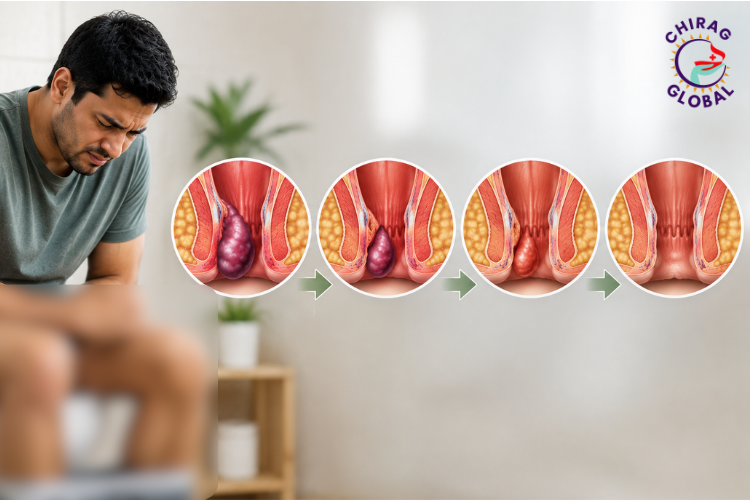

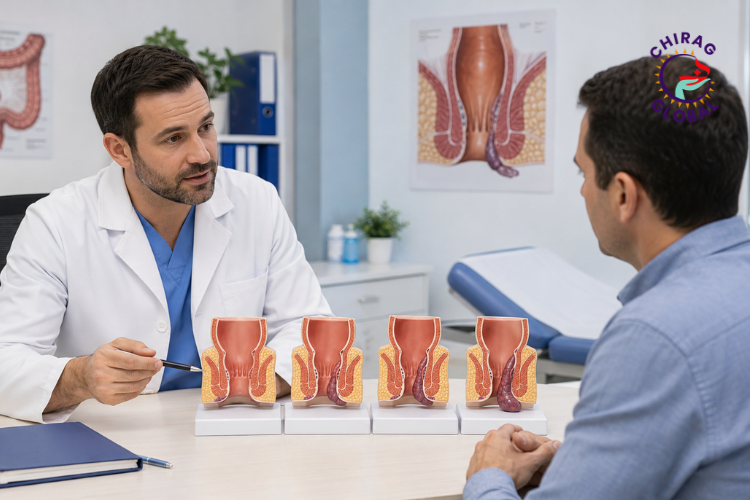
Prolapsed hemorrhoids occur when swollen internal hemorrhoidal tissue moves down from its normal position inside the anal canal and protrudes through the anus. Some prolapsed hemorrhoids may return inside on their own, while others may need to be gently pushed back or remain outside.
Many people notice prolapse as a lump or tissue coming out during bowel movements. It can be associated with bleeding, mucus, itching, irritation, difficulty cleaning the area, or discomfort.
Prolapse does not necessarily mean that surgery is required. Treatment depends on the severity of the prolapse, symptoms, whether the tissue can be reduced, and how much it affects daily life.
At Chirag Global Hospitals, Bangalore, patients experiencing hemorrhoidal prolapse can undergo specialist assessment to determine the grade of hemorrhoids and discuss appropriate treatment options.
Book a Consultation | Call 08065903127
What Are Prolapsed Hemorrhoids?
Internal hemorrhoids are swollen vascular tissues located inside the anal canal. Normally, they remain inside the rectum and help with bowel control.
When the supporting tissues weaken and the hemorrhoids enlarge, they can gradually move downward.
This is called hemorrhoidal prolapse.
A person may notice tissue:
- Coming out while passing stool
- Appearing after straining
- Protruding during prolonged toilet sitting
- Returning inside after the bowel movement
- Requiring manual pushing to return inside
- Remaining outside the anus
The severity depends on the degree of prolapse.
What Do Prolapsed Hemorrhoids Look or Feel Like?
People may describe prolapsed piles as a:
- Soft lump
- Swollen mass
- Tissue protruding from the anus
- Pinkish or reddish tissue
- Moist tissue that becomes irritated
- Lump that appears during bowel movements
The appearance can vary considerably.
Not every lump around the anus is a prolapsed hemorrhoid. Anal skin tags, external hemorrhoids, rectal prolapse, polyps, and other conditions can sometimes produce similar symptoms.
A new or persistent protruding mass should therefore be assessed if the diagnosis is uncertain.
What Causes Hemorrhoids to Prolapse?
Several factors can increase pressure on the hemorrhoidal tissues or weaken their supporting structures.
Common contributors include:
Chronic Constipation
Hard stools and repeated straining can increase pressure in the anal canal.
Frequent Straining
Repeated forceful pushing during bowel movements can contribute to hemorrhoidal enlargement and prolapse.
Prolonged Toilet Sitting
Spending excessive time sitting on the toilet may increase pressure around the anal region.
Chronic Diarrhoea
Repeated bowel movements and irritation can also contribute to hemorrhoidal symptoms.
Pregnancy
Pregnancy can increase pressure on pelvic blood vessels and may contribute to hemorrhoids and prolapse.
Age-Related Tissue Changes
The supporting tissues that hold hemorrhoids in their normal position may weaken over time.
Heavy Lifting
Repeated activities that significantly increase abdominal pressure may contribute to hemorrhoidal symptoms in some people.
Symptoms of Prolapsed Hemorrhoids
Prolapse is the defining feature, but other symptoms can occur.
Common symptoms include:
- Tissue protruding from the anus
- Bright-red rectal bleeding
- Itching
- Mucus discharge
- Anal irritation
- Swelling
- A sensation of incomplete bowel emptying
- Difficulty cleaning after bowel movements
- Discomfort while sitting
- Pain when the prolapsed tissue becomes irritated
The severity of symptoms varies from person to person.
Do Prolapsed Hemorrhoids Always Cause Pain?
No.
Internal hemorrhoids can prolapse without causing severe pain.
However, prolapsed tissue can become irritated, swollen, or trapped outside the anal canal. In such situations, discomfort or pain may increase.
Severe pain should not automatically be considered a normal part of hemorrhoids.
A painful lump can have other causes, including a thrombosed external hemorrhoid or perianal abscess.
Can Prolapsed Hemorrhoids Bleed?
Yes.
Internal hemorrhoids can cause bright-red bleeding, particularly during or after bowel movements.
Blood may be noticed:
- On toilet paper
- On the surface of stool
- Dripping into the toilet
- In the toilet bowl
However, rectal bleeding should not automatically be attributed to hemorrhoids.
Other gastrointestinal and colorectal conditions can also cause bleeding.
If bleeding is recurrent, heavy, unexplained, or associated with other changes in bowel habits, medical evaluation is important.
What Happens If Prolapsed Hemorrhoids Are Ignored?
Some hemorrhoids remain stable for long periods, while others gradually become more symptomatic.
Possible problems include:
- Recurrent bleeding
- Persistent irritation
- Mucus discharge
- Difficulty maintaining hygiene
- Skin irritation
- Increasing prolapse
- Pain from trapped or thrombosed tissue
- Reduced quality of life
Ignoring recurrent symptoms does not necessarily make the condition worse, but persistent prolapse deserves assessment so that appropriate treatment can be considered.
Conclusion
Prolapsed hemorrhoids occur when internal hemorrhoidal tissue moves down and protrudes through the anus. The severity ranges from hemorrhoids that briefly appear during bowel movements to tissue that remains permanently outside.
Understanding the grade of prolapse can help guide treatment, but the grade alone does not determine whether surgery is necessary. Symptoms, frequency of prolapse, bleeding, discomfort, and response to other treatments also matter.
Preventing constipation, avoiding excessive straining, maintaining adequate fibre and fluid intake, staying active, and seeking evaluation for recurrent bleeding or prolapse can help manage the condition.
If you regularly notice hemorrhoidal tissue coming out during bowel movements or have persistent bleeding, pain, or swelling, Chirag Global Hospitals, Bangalore can provide specialist evaluation and discuss appropriate treatment options.
Visit Chirag Global Hospitals Today!
Frequently Asked Questions
What are prolapsed hemorrhoids?
Prolapsed hemorrhoids are internal hemorrhoidal tissues that move downward and protrude through the anus.
Can prolapsed hemorrhoids go away naturally?
Mild hemorrhoidal symptoms may improve with better bowel habits and treatment of constipation. Persistent or advanced prolapse may require medical or procedural treatment.
Can prolapsed hemorrhoids cause bleeding?
Yes. Internal hemorrhoids commonly cause bright-red rectal bleeding, particularly during bowel movements. However, other causes of rectal bleeding must also be considered.
Are prolapsed hemorrhoids the same as rectal prolapse?
No. Prolapsed hemorrhoids involve hemorrhoidal tissue, whereas rectal prolapse involves the rectal wall. The two conditions require different evaluation and treatment.
Can constipation worsen prolapsed hemorrhoids?
Yes. Hard stools and repeated straining can increase pressure around the anal canal and aggravate hemorrhoidal prolapse.