
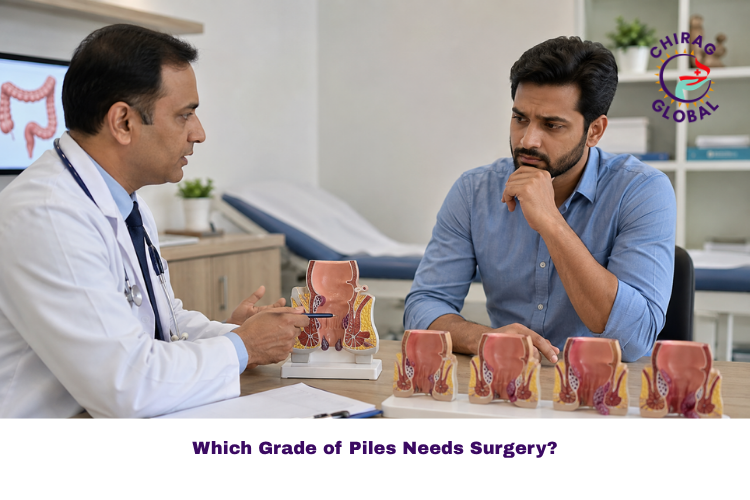
Piles, medically known as hemorrhoids, are swollen blood vessels and supporting tissues around the anus and lower rectum. They are commonly classified into four grades based mainly on whether internal hemorrhoids prolapse and whether they return inside the anus. One of the most common questions patients have after receiving a diagnosis is, “Which grade of piles needs surgery?”
The answer is not as simple as saying that one particular grade always requires an operation. Grade 1 piles usually respond to conservative treatment, while Grade 3 and Grade 4 piles are more likely to require a procedure or surgery when symptoms are persistent or severe. Some Grade 2 and Grade 3 piles can also be treated with minimally invasive procedures rather than conventional surgery.
At Chirag Global Hospitals, Bangalore, colorectal specialists assess the grade of hemorrhoids along with symptoms, prolapse, bleeding, bowel habits, previous treatment, and overall health before recommending an appropriate treatment plan.
Understanding piles surgery by grade can help you know when medical treatment may be enough and when a procedure could be necessary.
Book a Consultation | Call 08065903127
What Are the Four Grades of Piles?
Internal piles are generally classified into four grades.
| Grade | What Happens | Surgery Usually Needed? |
| Grade 1 | Piles remain inside the anal canal | Usually no |
| Grade 2 | Piles come out during bowel movements but return on their own | Usually no |
| Grade 3 | Piles come out and need to be pushed back manually | Sometimes |
| Grade 4 | Piles remain outside and cannot be pushed back | More likely |
This grading system describes the extent of prolapse. It does not, by itself, determine whether surgery is necessary.
Grade 1 Piles: Does It Need Surgery?
Usually, Grade 1 piles do not require surgery.
The hemorrhoids remain inside the anal canal and do not protrude outside during bowel movements.
Possible symptoms include:
- Bright-red bleeding during or after bowel movements
- Mild itching
- Irritation
- A feeling of incomplete bowel emptying
Treatment usually begins with measures that reduce pressure and straining on the hemorrhoidal tissues.
These may include:
- Increasing fibre intake
- Drinking adequate fluids
- Treating constipation
- Avoiding excessive straining
- Maintaining regular physical activity
If bleeding continues despite treatment, a doctor may recommend further evaluation and, in selected cases, a minimally invasive procedure.
Grade 2 Piles: Is Surgery Required?
Most Grade 2 piles do not require conventional surgery.
At this stage, hemorrhoids may protrude through the anus while passing stool but return inside on their own afterward.
Treatment may include lifestyle measures and minimally invasive procedures when symptoms persist.
Depending on the diagnosis, a specialist may consider treatments such as:
- Rubber band ligation
- Sclerotherapy
- Infrared coagulation
- Other appropriate office-based procedures
Surgery may be considered in selected patients if symptoms are persistent, recurrent, or difficult to control.
Grade 3 Piles: When Is Surgery Considered?
Grade 3 piles are more likely to require a procedure, but surgery is not automatically necessary.
Grade 3 hemorrhoids protrude during bowel movements or straining but do not return inside by themselves. They usually need to be manually pushed back.
Symptoms may include:
- Recurrent bleeding
- Prolapse
- Mucus discharge
- Itching
- Difficulty maintaining anal hygiene
- Discomfort while sitting or walking
Some Grade 3 hemorrhoids can be managed with minimally invasive procedures. However, if the prolapse is significant, symptoms keep returning, or other treatments have not provided adequate relief, surgical treatment may be recommended.
Therefore, Grade 3 piles treatment should be decided after an individual examination rather than based on grade alone.
Grade 4 Piles: Does It Usually Need Surgery?
Grade 4 piles are the most advanced grade of internal hemorrhoidal prolapse and are more likely to require surgical treatment.
In Grade 4 hemorrhoids, the prolapsed tissue remains outside the anus and cannot be pushed back inside.
Patients may experience:
- Persistent prolapse
- Bleeding
- Mucus discharge
- Irritation
- Difficulty cleaning the anal area
- Swelling
- Discomfort
- Thrombosis in some cases
Because the hemorrhoidal tissue remains permanently prolapsed, conservative treatment may not provide adequate relief. Depending on the patient’s condition, a colorectal surgeon may recommend an appropriate procedure or surgery.
Does Grade 3 or Grade 4 Always Mean Surgery?
No.
This is an important point when discussing which piles need surgery.
The grade indicates the degree of prolapse, but your treatment decision may also depend on:
- Severity of symptoms
- Frequency of bleeding
- Amount of prolapse
- Pain or discomfort
- Thrombosis
- Constipation
- Response to previous treatment
- Overall health
- Whether symptoms affect daily activities
For example, a patient with Grade 3 piles may be suitable for a minimally invasive treatment, while another patient with similar grading may benefit from surgery.
When Do Piles Need Surgery?
Apart from the grade, surgery or another procedure may be considered when piles cause persistent problems.
Persistent or Recurrent Bleeding
Repeated rectal bleeding requires medical assessment. Although hemorrhoids can cause bleeding, other causes need to be ruled out.
Significant Prolapse
If hemorrhoidal tissue repeatedly comes outside the anus and affects daily activities, treatment may be necessary.
Symptoms That Do Not Improve
When dietary changes, constipation management, medications, or appropriate non-surgical treatments fail to control symptoms, a procedure may be considered.
Recurrent Complications
Repeated episodes of severe swelling, thrombosis, or other hemorrhoidal complications may influence the treatment decision.
Difficulty Maintaining Hygiene
Large prolapsing hemorrhoids may cause mucus leakage and make cleaning difficult, resulting in persistent skin irritation.
What Are Minimally Invasive Piles Treatments?
When lifestyle measures are not enough, selected internal hemorrhoids can sometimes be treated without conventional surgery.
Rubber Band Ligation
A small band is placed around the base of the hemorrhoid, reducing its blood supply. The treated tissue gradually shrinks.
Sclerotherapy
A solution is injected into the hemorrhoidal tissue to reduce its size.
Infrared Coagulation
Heat is used to reduce the blood supply to selected internal hemorrhoids.
The suitability of these treatments depends on the grade and characteristics of the hemorrhoids.
What Surgical Treatments Are Available for Piles?
When surgery is appropriate, the choice depends on the size, location, prolapse, and symptoms.
Possible procedures include:
- Hemorrhoidectomy
- Stapled hemorrhoidopexy in selected cases
- Other procedure-based approaches depending on the patient’s condition
Your colorectal surgeon will explain the benefits, limitations, recovery, and potential risks of the recommended treatment.
Conclusion
So, which grade of piles needs surgery? There is no single grade at which surgery is automatically required. Grade 1 and many Grade 2 piles can usually be managed without surgery, while Grade 3 and especially Grade 4 piles are more likely to require a procedure or surgical treatment when prolapse and symptoms are significant.
The decision should be based on more than the grade. Persistent bleeding, recurrent prolapse, complications, severity of symptoms, and response to previous treatment all play a role in deciding when piles need surgery.
If you are experiencing recurrent bleeding, a prolapsing lump, persistent discomfort, or piles that are affecting your daily activities, a colorectal specialist at Chirag Global Hospitals, Bangalore can evaluate your condition and recommend whether lifestyle management, medication, a minimally invasive procedure, or surgery is appropriate.
Visit Chirag Global Hospitals Today!
Frequently Asked Questions
Which grade of piles needs surgery?
Grade 4 piles are more likely to require surgery, while some Grade 3 piles may also require surgical treatment. However, grade alone does not determine whether surgery is necessary.
When do piles need surgery?
Piles may need surgery when they cause significant or persistent prolapse, recurrent bleeding, complications, severe symptoms, or do not respond adequately to conservative or minimally invasive treatment.
Can Grade 3 piles be treated without surgery?
Yes. Some Grade 3 hemorrhoids can be treated with minimally invasive procedures. The appropriate treatment depends on the extent of prolapse and individual symptoms.
Do Grade 1 piles require surgery?
Usually not. Grade 1 hemorrhoids are commonly managed through dietary changes, constipation management, improved bowel habits, and appropriate medical treatment.
Does Grade 2 piles require an operation?
Usually not. Many Grade 2 hemorrhoids respond to lifestyle measures or minimally invasive procedures when necessary.
Is Grade 4 piles treatment always surgical?
Grade 4 piles are more likely to require surgery because the hemorrhoidal tissue remains prolapsed. However, the final treatment decision should be made after a specialist evaluation.
Can piles come back after surgery?
Yes. Recurrence is possible. Maintaining healthy bowel habits and managing constipation and straining can help reduce the risk.