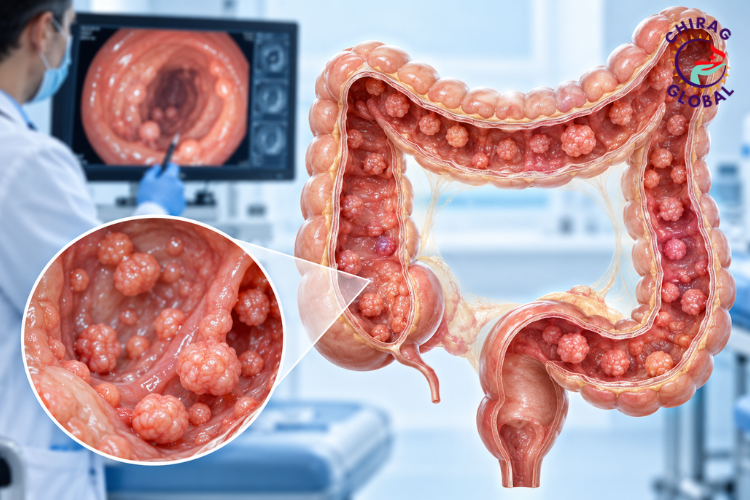

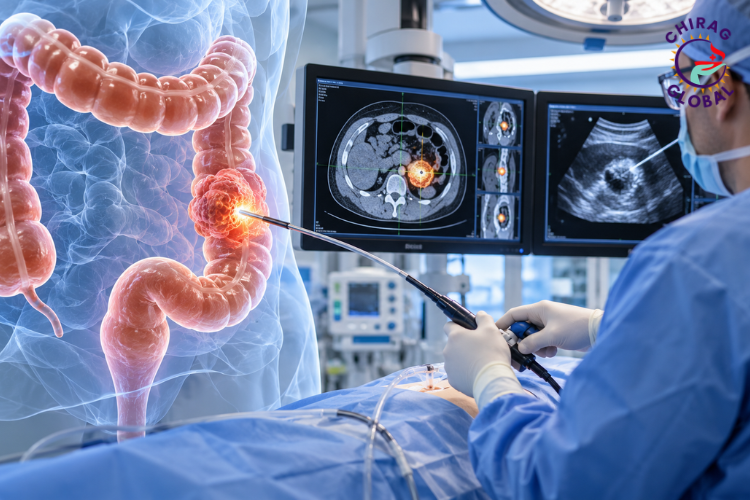
When colon cancer has spread to another organ, particularly the liver, treatment may involve more than one approach. In selected patients, local treatment can target specific tumour deposits while preserving as much healthy tissue as possible.
Local ablative therapy for colon cancer uses image guidance to place a probe into a tumour and destroy cancer cells with heat or, in some techniques, extreme cold. It is mainly considered for selected metastatic colorectal cancer, rather than as the routine treatment for the original tumour in the colon.
At Chirag Global Hospitals, Bangalore, treatment decisions should consider the cancer’s stage, lesion number and location, previous treatment and overall health.
If you or a family member has colon cancer or a limited number of metastatic lesions, speak with an oncology team to understand whether a local treatment could be part of the overall treatment plan at Chirag Global Hospitals, Bangalore.
Book a Consultation | Call 08065903127
What is local ablative therapy for colon cancer?
Local ablative therapy destroys a defined area of cancer without removing it through a major surgical operation. “Local” means the treatment is directed at a specific tumour rather than the whole body.
For colorectal cancer, ablation is most commonly considered for selected liver metastases. A patient may have a small number of liver lesions that could potentially be treated with surgery, ablation, radiation or a combination of local and systemic treatments.
Unlike systemic treatment, which can act on cancer cells throughout the body, ablation is directed at known lesions.
How does tumour ablation work?
The technique depends on tumour size, location and the patient’s clinical situation.
Radiofrequency ablation
Radiofrequency ablation (RFA) uses high-frequency electrical energy to create heat. A thin probe is positioned inside the tumour, commonly under CT or ultrasound guidance. The heat damages the targeted cancer cells.
Microwave ablation
Microwave ablation (MWA) also destroys tissue with heat, but uses microwave energy. It is used for selected tumours, including some colorectal cancer liver metastases.
Cryoablation
Cryoablation uses very low temperatures to freeze and destroy tumour tissue. Its use depends on tumour type, location and clinical circumstances.
The aim is to destroy the target lesion while limiting injury to nearby healthy structures. Imaging is central to planning and follow-up.
When is local ablation used for colon cancer?
Local ablation is not suitable for every patient. It is considered after assessing the cancer’s extent, tumour characteristics and the patient’s overall condition.
Selected liver metastases
The most common colorectal cancer application is selected liver metastases. Ablation may be considered when there are a limited number of lesions, particularly when they are relatively small and can be safely reached.
When surgery is difficult
Some liver lesions are difficult to remove surgically because of their location or because surgery could remove too much functioning liver. In selected cases, ablation may provide a tissue-sparing local option.
Limited recurrent disease
If colorectal cancer returns in a limited area after previous treatment, a multidisciplinary team may consider another local treatment. Previous surgery, chemotherapy, radiation and the location of recurrence all affect the decision.
Oligometastatic disease
Some patients have only a limited number of metastatic sites, often described as oligometastatic disease. Systemic treatment may be combined with surgery, ablation or another local treatment to control known lesions.
A liver metastasis does not automatically mean ablation is the best option. Number, size, location, resectability, tumour biology and overall health all matter.
Is ablation used for the primary colon tumour?
Usually, no. For most operable colon cancers, surgery to remove the affected section of the colon and nearby lymph nodes remains a standard local treatment.
Very early cancers may sometimes be removed through selected endoscopic procedures based on their depth, size, appearance and pathology.
Advanced colon cancer may require systemic treatments such as chemotherapy, targeted therapy or immunotherapy, depending on stage and molecular features. Local ablation is generally a targeted treatment for selected lesions, not a replacement for comprehensive cancer care.
How do doctors decide if ablation is suitable?
A multidisciplinary team usually reviews the complete clinical picture. Assessment may include:
- CT or MRI scans to map the primary and metastatic disease
- Liver imaging when liver metastases are suspected
- Colonoscopy and pathology results
- Blood tests, including CEA when clinically appropriate
- Molecular testing such as RAS, BRAF and mismatch repair or microsatellite instability testing when relevant
- Previous chemotherapy, surgery or other treatment
- General health and liver function
Location also matters. A tumour close to major blood vessels, bile ducts, bowel or other sensitive structures may be difficult or unsafe to treat.
What happens during local ablative therapy?
Image-guided ablation commonly involves:
1. Planning and anaesthesia
Imaging identifies the lesion and a safe probe route. Depending on the procedure, local anaesthesia, sedation or general anaesthesia may be used.
2. Image-guided probe placement
Using CT, ultrasound or another imaging method, the clinician guides a thin probe through the skin to the tumour.
3. Tumour destruction
Heat or extreme cold is delivered through the probe. Imaging helps the team monitor treatment and protect nearby structures.
4. Recovery and follow-up
The patient is monitored after treatment. Follow-up imaging checks the treated area for residual or recurrent disease.
What are the potential benefits and limitations?
For appropriately selected patients, local ablation may:
- Directly target a known tumour deposit
- Preserve healthy liver tissue in some cases
- Provide an option when surgery is difficult
- Be combined with systemic treatment or another local treatment
- Have a shorter recovery than some major operations
These are potential advantages, not guarantees. Ablation may not suit large, numerous or poorly positioned lesions, and systemic treatment may still be needed.
What are the risks of tumour ablation?
As with any procedure, ablation has potential risks. These can include pain, bleeding, infection, injury to nearby organs or structures, and complications related to anaesthesia or sedation.
Depending on the treatment site, there may be risks involving blood vessels, bile ducts or bowel. Some patients can experience a temporary flu-like reaction after ablation.
Incomplete treatment or local recurrence is another possibility. Careful planning and follow-up imaging are therefore important.
Ablation vs surgery: which is better?
There is no universal answer. For some patients with resectable colorectal liver metastases, surgery may be the preferred local treatment. For others, ablation may be a useful alternative or part of a combined strategy.
The decision can depend on:
- Number, size and location of metastases
- Relationship to blood vessels and bile ducts
- Amount of healthy liver that would remain after surgery
- Previous treatment and response
- Overall health and liver function
- Molecular and biological features of the cancer
If you have been told that colon cancer has spread to the liver or another limited site, ask whether the disease may be suitable for a local approach. A specialist review can help clarify whether surgery, ablation, systemic treatment or a combination is appropriate.
What should patients ask their cancer specialist?
Before deciding on local ablative therapy, ask:
- Where has the cancer spread, and how many lesions are present?
- Is surgery possible, and why is ablation being considered?
- Which ablation technique is recommended?
- What are the expected benefits and limitations?
- Will I also need systemic treatment?
- How will treatment response be monitored?
- What happens if the treated lesion returns?
The role of a multidisciplinary cancer team
Metastatic colon cancer can involve several treatment decisions. Depending on the case, care may involve medical oncology, colorectal or surgical oncology, interventional radiology, radiology and pathology.
This is important because local ablation should not be viewed in isolation. The best plan may involve systemic treatment first, local treatment after a response, surgery, ablation, radiation or a sequence of different treatments.
At Chirag Global Hospitals, Bangalore, patients can discuss their reports and treatment history with the appropriate specialist team.
Final takeaway
Local ablative therapy for colon cancer is a targeted treatment that can destroy selected tumour deposits, particularly certain colorectal cancer metastases in the liver. It may be considered when lesions are limited, accessible and suitable for local treatment, including some situations where surgery is difficult.
However, ablation is not a universal replacement for surgery or systemic cancer treatment. The right choice depends on the stage and biology of the cancer, the number and location of lesions, previous treatment and the patient’s overall health.
If you are looking for specialist evaluation for colon cancer or metastatic disease in Bangalore, contact Chirag Global Hospitals to discuss your reports and treatment options with an oncology team.
Frequently Asked Questions About Local Ablative Therapy for Colon Cancer
What is local ablative therapy for colon cancer?
Local ablative therapy is a targeted treatment that destroys a specific tumour using heat, cold or another form of energy. In colorectal cancer, it is most commonly considered for selected metastatic lesions, particularly in the liver.
Can colon cancer that has spread to the liver be treated with ablation?
In selected patients, yes. Ablation may be considered when there are a limited number of liver metastases that are suitable for safe image-guided treatment. The decision depends on lesion size, location, number, tumour biology and the patient’s overall health.
Is ablation better than surgery for colon cancer metastases?
Not necessarily. Surgery may be preferred when metastatic lesions can be safely removed. Ablation can be useful when surgery is difficult, would remove substantial healthy tissue or is otherwise not the preferred option. The choice is individualised.
How is radiofrequency ablation different from microwave ablation?
Both techniques use heat to destroy tumour tissue. Radiofrequency ablation uses high-frequency electrical energy, while microwave ablation uses microwave energy. The most appropriate technique depends on the tumour and its location.
Does ablation cure metastatic colon cancer?
Ablation can provide local control of selected tumour deposits, but it cannot guarantee that metastatic colon cancer has been completely eliminated. Some patients may require systemic treatment and continued imaging follow-up.
What are the side effects of tumour ablation?
Possible complications include pain, bleeding, infection and injury to nearby structures. The specific risks depend on the location of the tumour and the technique used.
Can ablation be combined with chemotherapy?
Yes. In selected patients, local ablation may be combined with chemotherapy or other systemic treatments. Treatment is usually planned according to the extent and biology of the cancer.
How do doctors know whether someone is suitable for ablation?
Doctors review imaging, tumour size and location, number of lesions, previous treatments, overall health, liver function and relevant molecular test results. A multidisciplinary cancer team may then compare ablation with surgery and other treatment options.