
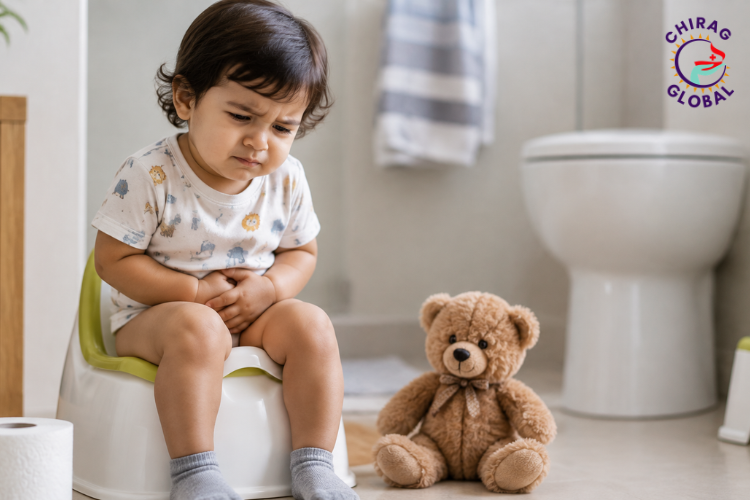
Constipation is common in young children, particularly around the time of toilet or potty training. A toddler who suddenly starts avoiding the toilet, cries when trying to pass stool, or goes several days without a bowel movement may be experiencing toddler constipation.
The problem is not always caused by food. A painful bowel movement can make a child afraid to poop, leading them to hold the stool in. The longer stool stays in the colon, the more water is absorbed from it, making the stool harder and more difficult to pass. This can create a cycle of pain → stool withholding → harder stool → more pain.
Understanding this cycle is important because simply telling a toddler to “go to the toilet” may not solve the problem.
Book a Consultation | Call 08065903127
What Is Toddler Constipation?
Constipation does not necessarily mean that a toddler must have a bowel movement every day. Children’s normal bowel patterns can vary.
Signs that may suggest constipation include:
- Fewer than two bowel movements in a week
- Hard, dry, or lumpy stools
- Large stools that are difficult to pass
- Pain or significant straining during bowel movements
- A child trying to avoid or delay pooping
- Feeling that the bowel has not completely emptied
- Bloating or a swollen abdomen
- Small amounts of blood associated with a hard stool
- Stool leaking into underwear in a toilet-trained child
NIDDK notes that stool withholding behaviors can include clenching the buttocks, standing on tiptoes, rocking back and forth, or appearing to perform unusual movements to avoid passing stool.
Why Does My Toddler Become Constipated?
There can be more than one reason.
1. Stool Withholding
One of the most common reasons children become constipated is holding in their stool.
A toddler may avoid pooping because:
- A previous bowel movement was painful
- They are afraid of the toilet
- They do not want to stop playing
- They feel uncomfortable using a different bathroom
- They are nervous about potty training
- They are experiencing changes at daycare or nursery
When stool is repeatedly held back, it remains in the colon longer and becomes harder.
2. Potty Training
Potty training can be an important turning point for some children.
A toddler may feel pressured to use the toilet before they are comfortable. If they associate the toilet with fear, pain, punishment, or pressure, they may begin avoiding bowel movements.
The NHS notes that constipation is particularly common around the age of 2 to 3 years, when many children are being toilet trained.
If constipation develops during potty training, temporarily reducing pressure and discussing the problem with the child’s healthcare professional may be appropriate.
3. Not Enough Fiber
A diet low in fiber can contribute to constipation.
Depending on age and sex, children generally need around 14–31 grams of fiber per day, although the appropriate amount for an individual toddler should be discussed with their healthcare professional. Fiber should be increased gradually.
Fiber-rich foods suitable for many toddlers include:
- Pears
- Apples with the skin when appropriate
- Oranges
- Vegetables
- Oats
- Whole-grain foods
- Lentils
- Beans
- Chickpeas
- Peas
The exact foods and textures should be appropriate for the child’s age and ability to eat safely.
4. Not Drinking Enough Fluids
Inadequate fluid intake can contribute to constipation.
Children who eat more fiber also need enough fluids for the fiber to work effectively. Fluid requirements vary according to a child’s size, health, activity level, diet, and climate.
Instead of focusing on a fixed amount for every toddler, parents should discuss appropriate fluid intake with their child’s pediatrician when constipation is persistent.
5. Changes in Routine
Toddlers can be sensitive to changes in their daily routine.
Constipation may appear around events such as:
- Starting daycare or nursery
- Travel
- Moving to a new home
- Changes in caregivers
- Toilet-training changes
- A new sibling
- Changes in meal routines
Stress or anxiety can also contribute to stool withholding in some children.
How Can You Tell If Your Toddler Is Holding Poop?
A toddler may not always tell you that they are constipated.
Instead, parents may notice behaviors such as:
- Hiding when they need to poop
- Crossing their legs
- Standing on their toes
- Clenching their buttocks
- Becoming unusually still
- Refusing to sit on the potty
- Crying when placed on the toilet
- Running away when asked to use the bathroom
- Repeatedly saying they do not need to poop
These behaviors can look like the child is trying to have a bowel movement when they are actually trying to prevent one. Stool withholding can worsen constipation over time.
Can a Toddler Be Constipated Even If They Have Loose Stool?
Yes.
This can be confusing for parents.
A child with a large amount of hard stool retained in the rectum may sometimes have softer or watery stool leaking around the harder stool. This is called overflow soiling. It can look like diarrhea even though constipation is the underlying problem.
If a toilet-trained toddler repeatedly soils their underwear with loose stool, constipation should be considered rather than assuming the child simply has diarrhea.
What Can Parents Do for Toddler Constipation?
Treatment depends on the child’s age, symptoms, severity, and cause.
Offer fiber-rich foods
Include age-appropriate sources of fiber in regular meals.
For example:
- Fruits
- Vegetables
- Whole grains
- Oats
- Beans
- Lentils
- Chickpeas
Increase fiber gradually rather than making a sudden major dietary change.
Encourage appropriate fluids
Offer water and other suitable fluids regularly.
If your toddler has a medical condition or has been advised to restrict fluids, follow the child’s healthcare professional’s recommendations.
Create a calm toilet routine
For a potty-trained toddler, a regular opportunity to sit on the toilet after meals can help establish a routine. The child should be comfortable and should not be forced to remain on the toilet for long periods.
Reduce pressure during potty training
If constipation has developed during toilet training, pressure can make stool withholding worse.
The NIDDK notes that a temporary break from potty training may be recommended until constipation improves.
Make the toilet comfortable
A toddler should be able to sit securely with their feet supported.
A suitable child-sized potty or toilet seat and foot support can help a child feel stable and comfortable while trying to pass stool.
Use positive reinforcement
Praise your child for sitting on the toilet, trying to poop, or following the bathroom routine.
Avoid punishment, embarrassment, or criticism for accidents.
The aim is to make bowel movements feel safe rather than stressful.
Should You Give a Toddler a Laxative?
Parents should not start laxatives, enemas, or other constipation medicines without guidance from the child’s healthcare professional.
Doctors may recommend laxatives or enemas for some children depending on the severity and cause of constipation. The type and dose need to be appropriate for the child’s age and situation.
If your toddler has been constipated for several days, repeatedly withholds stool, or has painful bowel movements, speak with a pediatrician rather than repeatedly trying different home remedies.
What Foods Should a Constipated Toddler Avoid?
There is no single food that needs to be eliminated from every toddler’s diet.
However, a diet dominated by foods with little or no fiber may make constipation more difficult to manage.
Examples include large amounts of:
- Chips
- Fast food
- Highly processed snack foods
- Some prepared foods
NIDDK recommends emphasizing fiber-rich foods and adequate fluids while reducing reliance on low-fiber foods when managing constipation in children.
A child’s complete diet matters more than blaming one individual food.
Can Toddler Constipation Cause Anal Fissures?
Yes.
Passing a large, hard stool can cause a small tear in the skin around the anus, known as an anal fissure.
This can make bowel movements painful. A child may then become afraid to poop and begin holding stool, which can worsen the constipation.
This creates a cycle:
Hard stool → anal pain → fear of pooping → stool withholding → harder stool
Breaking this cycle early can help prevent constipation from becoming persistent.
Can Constipation Affect a Toddler’s Bladder?
Persistent constipation can sometimes be associated with bladder-control problems.
NIDDK lists daytime or nighttime wetting among possible symptoms associated with constipation in children.
If a toddler has constipation together with new urinary symptoms, discuss both problems with a healthcare professional rather than treating them separately without evaluation.
When Should You Take a Toddler With Constipation to a Doctor?
Contact a healthcare professional if constipation:
- Continues for more than two weeks
- Does not improve with appropriate home measures
- Keeps returning
- Causes repeated painful bowel movements
- Leads to persistent stool withholding
- Is associated with repeated soiling
NIDDK recommends medical evaluation when a child’s constipation lasts more than two weeks or does not improve with home treatment.
When Is Toddler Constipation an Urgent Concern?
Seek prompt medical attention if constipation occurs with warning signs such as:
- Rectal bleeding or blood in the stool
- Significant abdominal swelling or bloating
- Constant abdominal pain
- Vomiting
- Unexplained weight loss
These symptoms may indicate a problem that needs medical evaluation.
Parents should also seek medical advice if a very young child has severe or unusual constipation, particularly when symptoms began very early in life or are accompanied by poor growth or other concerning symptoms.
Could a Medical Condition Be Causing the Constipation?
Most childhood constipation is related to functional factors such as stool withholding, diet, fluids, or toilet-training issues. However, certain medical conditions can also cause constipation.
Examples include:
- Celiac disease
- Hypothyroidism
- Hirschsprung disease
- Certain neurological or spinal conditions
- Metabolic disorders
- Structural problems affecting the digestive tract
Certain medicines and supplements, including some iron supplements and other medications, can also contribute to constipation.
This does not mean that a toddler with constipation necessarily has an underlying disease. Persistent, severe, unusual, or treatment-resistant constipation should simply be assessed appropriately.
How Do Doctors Diagnose Toddler Constipation?
A doctor will usually start with the child’s symptoms and medical history.
Parents may be asked:
- How often does the child poop?
- What does the stool look like?
- Is passing stool painful?
- Does the child hold stool?
- When did the problem begin?
- Is the child currently potty training?
- What foods and fluids does the child consume?
- Are there episodes of soiling?
- What medicines or supplements does the child take?
- Has the child had any other health problems?
A physical examination may also be performed. In selected cases, doctors may recommend laboratory tests, imaging, or specialized bowel-function testing to investigate an underlying cause.
Keeping a short record of bowel movements, stool appearance, pain, withholding behavior, and soiling can be useful when speaking with a doctor.
How Can Toddler Constipation Be Prevented?
Once constipation improves, maintaining healthy bowel habits can help reduce the chance of recurrence.
Parents can encourage:
- A varied diet containing age-appropriate fiber
- Adequate fluids
- Regular physical activity
- A predictable toilet routine
- Responding to the urge to poop
- A relaxed approach to potty training
- Positive reinforcement rather than punishment
The goal is to make bowel movements a normal part of the child’s routine rather than something associated with fear or conflict.
Key Takeaway
Toddler constipation is often more than a food problem.
For many toddlers, the cycle begins with a painful bowel movement. The child then starts holding stool, the stool becomes harder, and the next bowel movement becomes even more uncomfortable. Potty-training pressure, changes in routine, inadequate fiber or fluids, and other factors can add to the problem.
A calm toilet routine, age-appropriate fiber, adequate fluids, positive reinforcement, and early attention to stool withholding can help. If constipation persists, keeps returning, or is accompanied by warning signs, a healthcare professional should evaluate the child.
At Chirag Global Hospitals, parents can seek professional evaluation when a child’s constipation is persistent, recurrent, painful, or associated with other bowel symptoms, helping identify the cause and determine an appropriate treatment plan.
Visit Chirag Global Hospitals Today!
Frequently Asked Questions
How do I know if my toddler is constipated?
Hard or dry stools, painful bowel movements, fewer bowel movements, excessive straining, stool withholding, bloating, and soiling can all be signs of constipation. A child’s normal bowel frequency can vary, so stool consistency and difficulty passing stool are also important.
Why does my toddler hold their poop?
A toddler may hold stool because a previous bowel movement was painful, they are afraid of the toilet, they do not want to interrupt play, or they feel pressure during potty training. Holding stool can make it harder and more painful to pass later.
What should I feed my constipated toddler?
Age-appropriate fiber-rich foods such as fruits, vegetables, oats, whole grains, lentils, beans, and chickpeas can help provide fiber. Increase fiber gradually and make sure the child receives appropriate fluids.
Can potty training cause constipation?
Potty training itself does not necessarily cause constipation, but pressure, fear, or anxiety around toilet use can cause a child to hold stool. Constipation is particularly common around the age when many children are toilet training.
Can toddler constipation cause blood in the stool?
A large, hard stool can sometimes cause a small anal fissure, resulting in a small amount of blood. However, blood in a child’s stool should be discussed with a healthcare professional rather than automatically assumed to be from constipation.
Can a toddler have constipation and diarrhea at the same time?
What appears to be diarrhea can sometimes be liquid stool leaking around retained hard stool. This is known as overflow soiling and can occur with constipation.
Should I give my toddler a laxative for constipation?
Do not give a toddler a laxative or enema without advice from their healthcare professional. Doctors may recommend medication for some children, but the choice and dose depend on the child’s age and condition.
When should I see a doctor for toddler constipation?
Seek medical advice if constipation lasts more than two weeks, repeatedly returns, or does not improve with appropriate home measures. Seek prompt care if constipation occurs with bleeding, significant abdominal swelling, constant abdominal pain, vomiting, or weight loss.