


A painful lump near the anus that looks like a boil may seem like a simple skin infection. But if the same problem keeps coming back, it is worth looking beyond an ordinary boil.
Repeated lumps, swelling, pus or drainage around the anus can sometimes be associated with a perianal abscess or anal fistula. In other cases, recurring boil-like lesions on the buttocks, groin or around the anus may be related to a skin condition called hidradenitis suppurativa (HS).
The location matters because infections and inflammatory conditions around the anus can involve deeper tissues than a typical skin boil.
At Chirag Global Hospitals, recurring lumps or swelling near the anus can be evaluated to identify whether the problem is a simple skin infection, abscess, fistula or another anorectal condition.
Book a Consultation | Call 08065903127
Is It Really a Boil?
Not every lump near the anus is a boil.
People commonly use the word “boil” to describe almost any painful, swollen bump that develops under the skin. But several different conditions can look similar.
A lump near the anus could be:
- A skin boil
- A perianal abscess
- An anal fistula
- Hidradenitis suppurativa
- An infected cyst
- An inflamed hair follicle
- A pilonidal condition if the lump is higher in the buttock cleft
- Another anorectal or skin condition
An abscess is a collection of pus caused by infection. Around the anus, an abscess can develop from infection of one of the anal glands.
This distinction becomes particularly important when the lump repeatedly returns.
What Does a Perianal Abscess Feel Like?
A perianal abscess may appear as a painful swelling near the anus.
Possible symptoms include:
- A tender lump
- Increasing pain
- Redness
- Warmth around the area
- Swelling
- Pus
- Throbbing discomfort
- Pain when sitting
- Fever or feeling unwell
Some deeper abscesses may not produce an obvious lump on the skin. Instead, the main symptom can be significant pain or pressure around the anus or rectum.
This means that the absence of a visible “boil” does not always rule out an abscess.
Why Does the Same Boil Keep Coming Back?
This is one of the most important questions to ask.
If a lump repeatedly develops in the same area, drains and then returns, there may be an underlying problem that has not been completely resolved.
An Untreated or Recurring Abscess
An abscess may partially drain and temporarily feel better while infected material remains deeper inside.
This can lead to another episode of swelling and pain.
Some abscesses require drainage rather than relying on them to rupture or settle on their own.
An Anal Fistula
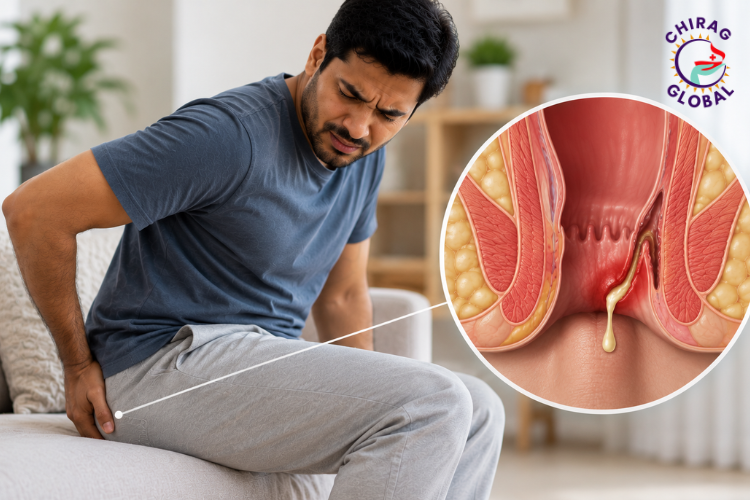
A previous abscess can leave behind an abnormal tunnel between the anal canal and the skin. This is called an anal fistula.
A fistula may produce intermittent drainage and swelling. The external opening can sometimes close temporarily, causing pressure or another abscess to develop before drainage resumes.
This creates a pattern that can look like a recurring boil:
Painful lump → pus drains → lump gets smaller → symptoms disappear → lump returns
If this cycle keeps happening, an anal fistula should be considered.
Could a Recurrent Boil Be an Anal Fistula?
Yes.
An anal fistula commonly develops after an anal abscess.
Once a fistula forms, it creates a persistent abnormal pathway between the anal canal and nearby skin. Symptoms may include:
- Recurrent swelling
- Pus or fluid drainage
- Foul-smelling discharge
- Skin irritation
- Pain
- A small opening or hole near the anus
- Repeated abscesses
Anal fistulas usually do not heal permanently without appropriate treatment.
A recurring “boil” near the anus therefore deserves more attention if it repeatedly appears in the same location.
What If the Lump Bursts and Pus Comes Out?
A burst lump may feel better because pressure has been released.
However, draining does not necessarily mean the underlying problem is gone.
If the lump was an abscess, some infected material may remain. If a fistula is present, the abnormal tract can continue to cause intermittent drainage and recurrent swelling.
You should not squeeze or repeatedly press the area to force drainage.
If the lump is painful, keeps returning or continues to drain, medical assessment is advisable.
Could Hidradenitis Suppurativa Cause Boils Near the Anus?
Yes.
Hidradenitis suppurativa (HS) is a chronic inflammatory skin condition that causes recurring boil-like lumps, abscesses, drainage and scarring.
It commonly affects areas where skin rubs together, including:
- Groin
- Buttocks
- Around the anus
- Armpits
- Inner thighs
- Under the breasts
HS can begin as painful, firm lumps that resemble ordinary boils. Over time, recurring lesions can form tunnels under the skin and leave scars.
One useful clue is where else you get similar lumps.
If you repeatedly develop painful boil-like lesions in the armpits, groin, buttocks or inner thighs as well as near the anus, HS becomes more important to consider.
How Is Hidradenitis Suppurativa Different From an Anal Fistula?
Although they can look similar, they are not the same condition.
| Feature | Anal Fistula | Hidradenitis Suppurativa |
| Main problem | Abnormal tract connecting the anal canal to nearby skin | Chronic inflammatory condition involving hair follicles |
| Common pattern | Recurrent swelling and drainage near the anus | Repeated boil-like lumps in multiple skin-fold areas |
| Previous abscess | Often present | Not necessarily |
| Drainage | Pus, blood or other fluid may occur | Pus drainage is common |
| Scarring | May occur around repeated openings | Repeated lesions can cause significant scarring |
| Other locations | Usually focused around anus | Groin, armpits, buttocks, thighs and other areas |
A medical examination can help distinguish between these conditions. HS is diagnosed mainly through the pattern of lesions, their locations and the patient’s history; there is no single definitive test for it.
Could It Be an Infected Hair Follicle?
Sometimes.
Hair follicles around the buttocks and groin can become inflamed or infected, producing small painful bumps.
A superficial follicle-related infection may behave differently from an abscess originating deeper around the anus.
If the lesion is small, isolated and resolves without recurring, it may be less concerning than a painful lump that repeatedly develops in exactly the same place.
However, location and recurrence make an examination useful when the cause is uncertain.
Can Poor Hygiene Cause Recurrent Boils Near the Anus?
Not necessarily.
It is easy to assume that recurring lumps around the anus must be caused by poor hygiene, but that is not a reliable explanation.
For example, hidradenitis suppurativa is not caused by poor hygiene.
Similarly, an anal abscess generally develops because of infection involving an anal gland rather than simply because the surrounding skin was not clean enough.
Good hygiene is still important for skin health, but repeatedly scrubbing the area will not prevent an underlying fistula or inflammatory skin condition.
Can Constipation Cause Boils Near the Anus?
Constipation does not usually directly cause a boil.
However, constipation can contribute to other anorectal problems and may complicate recovery from conditions around the anus.
If you have a painful lump along with constipation, bleeding or pain during bowel movements, it is important not to assume that constipation is the sole cause.
A lump that produces pus or repeatedly returns needs separate evaluation.
What Should You Do If You Keep Getting These Lumps?
The most useful step is to stop treating every episode as an isolated boil.
Keep track of the pattern.
Ask yourself:
- Does it occur in exactly the same place?
- Does it become swollen and painful?
- Does pus drain from it?
- Does it leave a small opening?
- Does it disappear and then return?
- Does the area become swollen again when drainage stops?
- Do you have similar lumps elsewhere on your body?
- Have you previously had an abscess drained?
- Do you have symptoms such as chronic diarrhea, abdominal pain or unexplained weight loss?
These details can help your doctor determine whether the problem is more consistent with an abscess, fistula, HS or another condition.
Should You Squeeze a Boil Near the Anus?
It is better not to.
Squeezing or puncturing a painful lump can damage the surrounding tissue and may push infection deeper.
It also does not address a possible underlying fistula.
If an abscess requires drainage, a healthcare professional can determine the safest approach. Perianal abscesses may require a procedure to drain the collection of pus.
Avoid using needles or attempting to cut the lump open yourself.
Do Antibiotics Cure a Recurrent Boil Near the Anus?
That depends on the underlying condition.
Antibiotics may be appropriate for certain bacterial infections, but they are not a universal solution for every recurrent lump.
If an abscess has formed, antibiotics alone may not adequately drain the collection. Some abscesses require drainage.
Likewise, antibiotics do not eliminate the abnormal tract of an established anal fistula.
This is why repeatedly taking antibiotics without determining the cause may delay appropriate treatment.
When Should You See a Doctor About a Boil Near the Anus?
Consider medical evaluation if the lump:
- Keeps returning
- Occurs in the same location
- Drains pus repeatedly
- Leaves a small opening
- Causes significant pain
- Makes sitting difficult
- Becomes increasingly swollen
- Is accompanied by bleeding
- Does not heal properly
- Leaves repeated scars
Recurring perianal swelling and drainage are particularly important because they can indicate an anal fistula or another chronic condition.
When Is a Recurrent Anal Boil Urgent?
Seek prompt medical care if you develop:
- Severe or rapidly increasing pain
- A rapidly enlarging lump
- Fever or chills
- Significant redness or warmth
- Pus with worsening pain
- Feeling generally unwell
- Difficulty passing urine
- Severe rectal or pelvic pressure
An abscess can sometimes be deeper than it appears from the outside. Fever, swelling, redness and significant pain can be signs of an active infection.
Do not wait for a painful abscess to repeatedly burst on its own.
How Is a Recurrent Lump Near the Anus Diagnosed?
Diagnosis starts with a detailed history and physical examination.
Your doctor may look for:
- The exact location of the lump
- An external opening
- Drainage
- Scarring
- Redness
- Swelling
- Previous surgical scars
- Other lesions on the buttocks or groin
If a fistula is suspected, imaging may sometimes be recommended, particularly for recurrent or complex disease.
MRI, ultrasound or CT can help identify an abscess or map a fistula when the tract is difficult to determine through examination alone.
For suspected HS, the pattern and location of recurring skin lesions are particularly important.
What Treatment Might Be Needed?
Treatment depends entirely on the cause.
If It Is a Simple Skin Infection
A doctor may recommend appropriate local care or medication depending on the infection.
If It Is a Perianal Abscess
The priority may be draining the collection of pus. Some abscesses require a surgical drainage procedure.
If It Is an Anal Fistula
Treatment is usually aimed at addressing the abnormal tract. Depending on its anatomy, options can include fistulotomy, seton placement or other sphincter-preserving procedures.
If It Is Hidradenitis Suppurativa
Treatment is different and may involve medications, lifestyle measures and, in more severe cases, procedures or surgery. Early diagnosis can help prevent progression and scarring.
This is why identifying the actual cause is more useful than repeatedly treating the lump as an ordinary boil.
What Does a Recurring Pattern Tell You?
A single painful bump may be relatively straightforward.
A repeating pattern deserves more attention.
For example:
Lump → pus → relief → healing → same lump returns
may suggest that something underneath the skin is continuing to cause the problem.
Similarly:
Several boil-like lumps → drainage → new nearby lumps → scarring
may fit a pattern more consistent with hidradenitis suppurativa.
Neither pattern is enough to make a diagnosis by itself, but both are reasons to seek an appropriate examination.
Conclusion
If you keep getting boils near your anus, do not assume that each episode is simply another ordinary skin infection.
Recurring painful lumps, pus drainage or swelling may be associated with a perianal abscess or anal fistula, while repeated boil-like lesions across the buttocks, groin or other skin-fold areas can be a feature of hidradenitis suppurativa.
A lump that repeatedly returns in the same location—especially after previously draining pus—deserves medical evaluation.
At Chirag Global Hospitals, patients with recurrent lumps, swelling, drainage or suspected fistula can be assessed by a colorectal and proctology team to determine the underlying cause and discuss appropriate treatment.
Visit Chirag Global Hospitals Today!
Frequently Asked Questions
1. Why Do I Keep Getting Boils Near My Anus?
Repeated lumps may be caused by recurrent abscesses, an underlying anal fistula, hidradenitis suppurativa, infected follicles or another skin or anorectal condition. The cause cannot be determined reliably from appearance alone.
2. Can a Boil Near the Anus Turn Into a Fistula?
A perianal abscess can sometimes lead to an anal fistula. A fistula is an abnormal tunnel between the anal canal and nearby skin and may cause recurrent swelling or drainage.
3. Why Does the Same Anal Boil Keep Coming Back?
If the same area repeatedly swells, drains and then becomes painful again, an underlying fistula or incompletely resolved abscess may be responsible.
4. Could Recurrent Boils Near My Anus Be Hidradenitis Suppurativa?
Yes. HS can cause recurring painful, boil-like lumps and abscesses around the anus, buttocks, groin and other skin-fold areas. Scarring and tunnels under the skin can develop over time.
5. Should I Pop a Boil Near My Anus?
No. Avoid squeezing, puncturing or cutting the lump yourself. If an abscess needs drainage, it should be assessed and treated appropriately by a healthcare professional.
6. Can Antibiotics Prevent Recurrent Anal Boils?
Antibiotics may be useful for certain infections, but they do not necessarily resolve an abscess or an established anal fistula. Recurrent symptoms should be evaluated to identify the underlying cause.
7. When Should I Worry About a Lump Near My Anus?
Severe pain, rapidly increasing swelling, fever, chills, spreading redness, significant pus or feeling unwell can indicate an abscess or infection requiring prompt medical attention.
8. Can a Recurring Anal Boil Go Away on Its Own?
A lump may shrink or drain temporarily, but repeated episodes should not be assumed to have resolved permanently. An underlying fistula or other condition may continue to cause recurrence.