
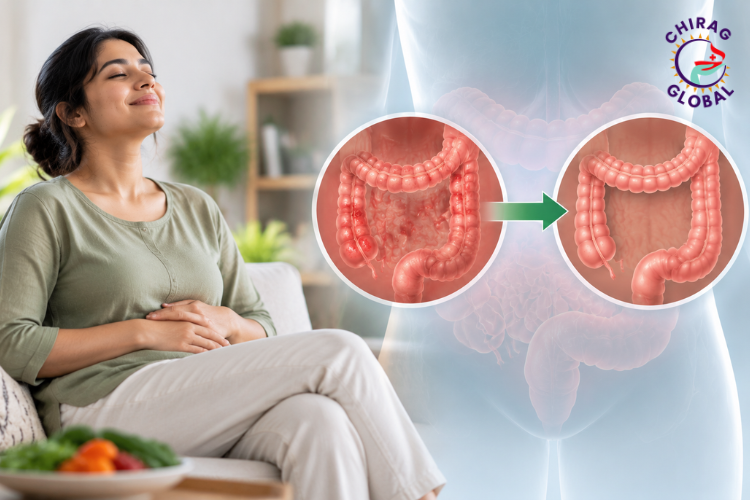
For someone living with ulcerative colitis, hearing the word remission can feel like a major milestone. Symptoms may settle, bowel movements may become more predictable, and everyday activities may feel normal again.
However, there is an important distinction that many patients may not realize:
Feeling better does not always mean that inflammation in the intestine has completely disappeared.
Ulcerative Colitis Remission generally refers to a period when the disease is controlled and symptoms are reduced or absent. Doctors may assess remission in different ways, including symptom control and evidence of reduced or healed inflammation in the bowel.
Treatment is therefore not simply about making symptoms disappear. It also aims to control inflammation and maintain remission over time.
At Chirag Global Hospitals, understanding what remission means can help patients approach ulcerative colitis as a condition that requires ongoing management and monitoring, rather than treatment only when symptoms become severe.
Book a Consultation | Call 08065903127
Is Ulcerative Colitis Remission the Same as Being Cured?
No.
Ulcerative colitis is a chronic inflammatory bowel disease. Medical treatment aims to control the condition, induce remission, and maintain that remission for as long as possible.
Periods without symptoms can last for months or years, but ulcerative colitis can become active again and cause a flare.
A simple way to understand the difference is:
Remission = the disease is controlled
Cure = the underlying disease has permanently gone away
These terms should not be used interchangeably.
A person who is ulcerative colitis in remission can often experience a significant improvement in quality of life, but continued medical care may still be necessary.
What Are the Different Types of Remission in Ulcerative Colitis?
The word “remission” can mean different things depending on what your doctor is assessing.
Clinical Remission
Clinical remission in ulcerative colitis generally refers to having few or no symptoms of active disease.
This may include:
- Little or no rectal bleeding
- Fewer bowel movements
- Reduced urgency
- Less abdominal discomfort
- Improved energy
- Better day-to-day functioning
For many patients, symptom improvement is one of the first signs that treatment is working.
However, symptoms alone cannot always show whether inflammation has completely settled inside the colon.
Endoscopic Remission
Endoscopic assessment allows a gastroenterologist to examine the lining of the colon directly.
If the bowel lining shows no or minimal visible inflammation, this provides additional evidence that the disease is well controlled.
This distinction is important because a person can feel well while inflammation is still present.
Histologic Healing
During a colonoscopy, tissue samples may sometimes be collected for examination under a microscope.
Histologic assessment can provide additional information about microscopic inflammation that may not be obvious from symptoms or the visible appearance of the bowel.
Not every patient requires repeated tissue assessment solely to determine remission. The appropriate monitoring approach depends on factors such as disease history, treatment, symptoms, and previous test results.
Why Can You Feel Fine When Inflammation Is Still Present?
Ulcerative colitis symptoms do not always perfectly reflect the amount of inflammation in the bowel.
A person may have:
- Normal or nearly normal bowel movements
- No visible blood
- Little abdominal discomfort
- Good energy
while some intestinal inflammation remains.
This is one reason doctors may use blood tests, stool inflammatory markers, or endoscopic assessment in addition to discussing symptoms.
The goal is to understand whether the disease is adequately controlled rather than relying only on how you feel.
What Does Ulcerative Colitis Remission Look Like in Everyday Life?
For many people, remission means being able to return to ordinary routines with fewer interruptions from bowel symptoms.
You may be able to:
- Sleep without repeated bowel urgency
- Leave home without constantly searching for a toilet
- Work or study more comfortably
- Exercise more regularly
- Travel with greater confidence
- Spend time socially without worrying about sudden bowel symptoms
- Follow a broader and more comfortable diet based on individual tolerance
The psychological benefits can also be significant.
Living with frequent diarrhea, urgency, bleeding, or uncertainty can affect confidence and daily planning. When these symptoms settle, quality of life may improve considerably.
However, feeling well should be viewed as a reason to continue effective disease management, not automatically as a reason to stop treatment.
Can You Stop Ulcerative Colitis Medication During Remission?
You should generally not stop, reduce, or change ulcerative colitis medication simply because you feel better unless your treating doctor recommends a change.
Maintenance treatment may be used to reduce the risk of future flares and keep the disease controlled.
The medication used depends on factors such as:
- Disease severity
- Extent of ulcerative colitis
- Previous flares
- Response to treatment
- Previous medications
- Side effects
- Individual health considerations
If you are considering stopping or reducing medication because you are feeling well, discuss this with your gastroenterologist first.
Why Is Maintaining Remission Important?
Achieving remission is only one part of long-term ulcerative colitis management.
The next goal is maintaining remission and preventing or reducing future disease activity.
A maintenance treatment plan may help:
- Reduce the risk of flares
- Keep intestinal inflammation controlled
- Preserve symptom improvement
- Support healing of the bowel lining
- Reduce disruption to everyday life
The appropriate maintenance strategy varies from person to person.
What Happens During an Ulcerative Colitis Flare?
A flare occurs when ulcerative colitis becomes active again after a period of controlled disease.
Possible symptoms include:
- Increased bowel movements
- Loose or watery stools
- Blood in the stool
- Increased urgency
- Abdominal cramps
- Rectal discomfort
- Fatigue
- Reduced appetite
- Unintentional weight loss in more significant disease
Persistent diarrhea, particularly when accompanied by blood or abdominal pain, should be discussed with a healthcare professional.
A flare does not necessarily mean that your long-term treatment has permanently failed. Your gastroenterologist may need to determine whether active inflammation, infection, medication-related issues, or another problem is responsible.
Can Ulcerative Colitis Flare After Years of Remission?
Yes.
Remission can last for long periods, but ulcerative colitis can become active again.
This is why people with ulcerative colitis should remain familiar with their usual symptoms and pay attention to persistent changes.
A sudden increase in bowel frequency, new rectal bleeding, increased urgency, or persistent diarrhea should not automatically be dismissed as something you ate.
Early communication with your gastroenterology or IBD care team can help determine whether symptoms represent a flare or another condition.
How Is Ulcerative Colitis Remission Monitored?
Monitoring is individualized and may involve a combination of symptoms, laboratory tests, stool tests, and endoscopic assessment.
Symptom Assessment
Your doctor may ask about:
- Bowel frequency
- Stool consistency
- Rectal bleeding
- Urgency
- Abdominal pain
- Night-time symptoms
- Energy levels
- Weight changes
These details can help determine whether symptoms are consistent with controlled disease or possible activity.
Blood Tests
Blood tests may help identify signs of inflammation and complications such as anemia.
They can also be used to monitor the safety of certain medications.
Stool Tests
Stool inflammatory markers, such as fecal calprotectin, may be used in some patients to help assess intestinal inflammation.
These tests can provide useful information without immediately requiring an invasive examination.
Colonoscopy and Other Endoscopic Tests
Endoscopy allows the doctor to directly assess the lining of the colon.
It can help determine whether visible inflammation is present and allows biopsies to be collected when appropriate.
The timing and frequency of endoscopic assessment depend on the individual’s disease history, symptoms, treatment, and clinical needs.
Does Diet Change When Ulcerative Colitis Is in Remission?
There is no single ulcerative colitis remission diet that works for everyone.
When symptoms are controlled, many people can follow a balanced diet that provides adequate:
- Protein
- Carbohydrates
- Healthy fats
- Fiber according to individual tolerance
- Vitamins and minerals
- Fluids
Some foods may continue to trigger digestive symptoms in particular individuals. However, a food causing symptoms does not necessarily mean that it is causing ulcerative colitis inflammation.
Unnecessarily eliminating large numbers of foods can also make it harder to meet nutritional needs.
If you continue to experience food-related symptoms during remission, discuss them with your gastroenterologist or a qualified dietitian before making major dietary restrictions.
Can Stress Cause an Ulcerative Colitis Flare?
Stress can affect gastrointestinal symptoms and may make living with inflammatory bowel disease more difficult.
However, ulcerative colitis is an inflammatory condition and should not be described simply as a “stress disease.”
If symptoms return, it is important to consider active inflammation and other possible causes rather than assuming that stress alone is responsible.
Managing stress, getting adequate sleep, staying physically active when appropriate, and maintaining a regular routine can still support overall wellbeing.
What Should You Do If Ulcerative Colitis Symptoms Return?
Do not necessarily wait until symptoms become severe before contacting your healthcare team.
Pay attention to changes such as:
Normal routine → increased bowel frequency → urgency → mucus or blood → persistent diarrhea
A change that continues or progresses deserves medical attention.
Your doctor may assess whether the symptoms are caused by:
- An ulcerative colitis flare
- An intestinal infection
- Medication-related effects
- Irritable bowel-type symptoms
- Food intolerance
- Another gastrointestinal condition
Because these problems can produce similar symptoms, testing may sometimes be necessary.
When Is an Ulcerative Colitis Flare an Emergency?
Some ulcerative colitis flares can become severe and require urgent medical care.
Seek urgent medical attention if you develop severe or rapidly worsening symptoms, particularly:
- Frequent bloody diarrhea
- Severe abdominal pain
- Significant abdominal swelling
- Fever
- Rapid heartbeat
- Severe weakness
- Signs of significant dehydration
- Dizziness or fainting
- Inability to keep fluids down
- A marked deterioration in your general condition
Severe ulcerative colitis may require hospital-based treatment, so significant deterioration should not be managed solely with home remedies.
Can You Live Normally During Ulcerative Colitis Remission?
For many people, yes.
Effective treatment can lead to long periods in which ulcerative colitis has little impact on everyday activities.
During remission, you may be able to:
- Work normally
- Exercise
- Travel
- Socialize
- Plan activities
- Maintain relationships
- Pursue personal goals
The key is to view remission as controlled disease rather than permanent disappearance of the condition.
Keeping medical appointments, following the recommended treatment plan, and responding early to changes can help support long-term disease control.
What Should You Remember About Ulcerative Colitis Remission?
The most important point is simple:
Remission is more than the absence of symptoms.
A person may feel completely well while some intestinal inflammation remains. Conversely, digestive symptoms do not always mean that ulcerative colitis is active.
This is why a complete assessment may consider symptoms, blood tests, stool inflammatory markers, and, when appropriate, endoscopic findings.
The two broad goals of treatment are:
1. Achieve remission
2. Maintain remission
If you are feeling better, that is encouraging. However, it is not usually a reason to stop prescribed treatment without discussing it with your healthcare team.
Conclusion
Ulcerative Colitis Remission means that the disease is controlled, but it does not necessarily mean that ulcerative colitis has been permanently cured.
Symptoms, intestinal inflammation, and endoscopic findings do not always change in exactly the same way. For this reason, appropriate monitoring can be an important part of long-term care.
Continuing prescribed treatment, attending recommended follow-ups, maintaining a healthy routine, and recognizing early changes can all help support remission.
If symptoms such as persistent diarrhea, rectal bleeding, increased urgency, abdominal pain, or unexplained weight loss return, speak with your healthcare team rather than assuming that the symptoms will resolve on their own.
At Chirag Global Hospitals, patients with ulcerative colitis can seek specialist evaluation for disease monitoring, recurrent symptoms, and individualized treatment planning.
Visit Chirag Global Hospitals Today!
Frequently Asked Questions
What is remission in ulcerative colitis?
Remission is a period when ulcerative colitis is controlled and symptoms are reduced or absent. Doctors may also assess whether there is evidence of ongoing intestinal inflammation.
Can ulcerative colitis be completely cured?
Ulcerative colitis is a chronic condition, and medication does not permanently cure it for everyone. Treatment aims to achieve and maintain remission. Surgery to remove the colon and rectum can eliminate ulcerative colitis from the removed bowel, but it is a major treatment decision and is not appropriate for everyone.
Can ulcerative colitis still be active without symptoms?
Yes. Symptoms do not always perfectly reflect the amount of inflammation in the bowel. This is why doctors may use blood tests, stool markers, or endoscopic assessment when appropriate.
Should I continue my ulcerative colitis medicine during remission?
Maintenance treatment is commonly used to help prevent disease activity from returning. Do not stop or change prescribed medication without discussing it with your treating doctor.
How long can ulcerative colitis remission last?
Remission can last for months or years, but the duration varies between individuals. Ulcerative colitis can become active again, which is why ongoing management remains important.
What are the early signs that remission may be ending?
A return of frequent bowel movements, urgency, diarrhea, blood or mucus in the stool, abdominal cramps, or increasing fatigue may indicate that the disease is becoming active again. Persistent changes should be discussed with your healthcare team.
Is a special diet necessary during ulcerative colitis remission?
Not necessarily. Many people can follow a balanced diet during remission. Individual food sensitivities or ongoing digestive symptoms may require personalized dietary advice rather than a universally restrictive diet.