

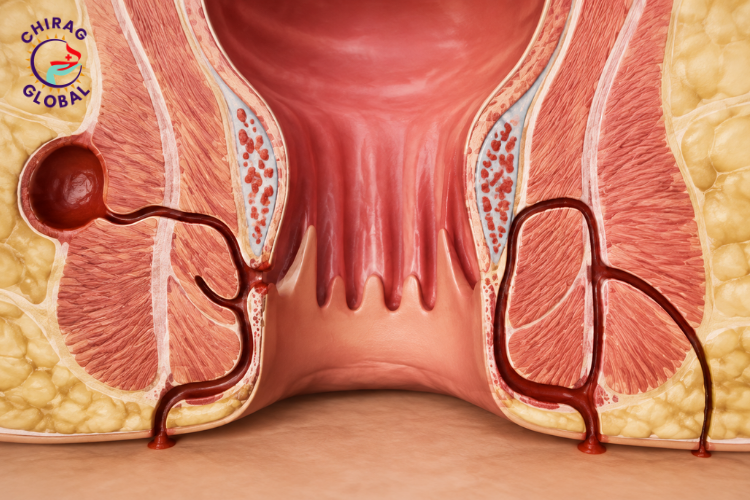
An anal fistula is an abnormal tunnel that develops between the inside of the anal canal or rectum and the skin around the anus. It commonly develops after an anal abscess has drained, leaving behind a persistent tract between the infected area and the skin.
Not all anal fistulas follow the same path. Their location and relationship with the anal sphincter muscles are important because they influence symptoms, diagnosis, and treatment.
Understanding the different anal fistula types is particularly important when planning treatment because the goal is not simply to close the fistula. Treatment must also protect normal bowel-control function.
The main anatomical classification includes intersphincteric, transsphincteric, suprasphincteric, and extrasphincteric fistulas. Some fistulas may also be described as simple or complex depending on their anatomy and associated conditions.
Book a Consultation | Call 08065903127
What Is an Anal Fistula?
An anal fistula is a small abnormal passage connecting the anal canal or rectum with the skin near the anus.
It may develop when an infection in an anal gland forms an abscess. After the abscess drains, either naturally or through treatment, a tract may remain.
Common symptoms include:
- Persistent or recurrent discharge near the anus
- Pus or blood-stained discharge
- A small opening in the skin
- Recurrent swelling
- Pain, particularly when an abscess develops
- Skin irritation
- A lump near the anus
- Repeated episodes of an abscess
Some fistulas may temporarily stop draining and then become painful again when the external opening closes.
The Main Anal Fistula Types
1. Intersphincteric Fistula
An intersphincteric fistula travels between the internal and external anal sphincter muscles.
It is generally considered one of the more common fistula patterns.
The tract typically begins near the anal canal and passes through the space between the sphincter muscles before reaching the skin around the anus.
Possible Symptoms
People may experience:
- Recurrent discharge
- A small opening near the anus
- Intermittent swelling
- Pain when infection develops
- Repeated abscess formation
Treatment
Treatment depends on the exact anatomy and amount of sphincter involvement.
For selected simple fistulas, a fistulotomy may be appropriate. Other approaches may be considered when preserving sphincter function is a priority.
2. Transsphincteric Fistula
A transsphincteric fistula passes through both the internal and external anal sphincter muscles.
Because it crosses a greater amount of sphincter tissue, treatment requires careful planning.
The fistula may extend from the anal canal through the sphincter complex and then reach the skin surrounding the anus.
Why Is It Important?
Dividing too much sphincter muscle during treatment can increase the risk of problems with bowel control.
Therefore, the surgeon needs to determine the exact course of the tract before selecting the procedure.
Depending on the anatomy, treatment options may include:
- Fistulotomy in carefully selected cases
- Seton placement
- LIFT procedure
- Advancement flap
- Other sphincter-preserving techniques
The appropriate option depends on the individual fistula.
3. Suprasphincteric Fistula
A suprasphincteric fistula travels upward around the external sphincter before descending toward the skin.
It typically passes above the external sphincter rather than directly through it.
Because of its higher and more complex course, treatment can be more challenging than for a straightforward superficial fistula.
Imaging such as MRI may be useful when the anatomy is unclear or complex disease is suspected.
4. Extrasphincteric Fistula
An extrasphincteric fistula travels outside the external anal sphincter.
It is uncommon and may have a different underlying cause from the typical fistula that develops after an anal gland infection.
Possible causes may include:
- Previous pelvic surgery
- Trauma
- Inflammatory bowel disease
- Other pelvic conditions
Because of its unusual anatomy, determining the underlying cause is particularly important before treatment.
Simple vs Complex Anal Fistulas
Anal fistulas may also be described as simple or complex.
This classification is different from the anatomical Parks classification.
Simple Anal Fistula
A simple fistula generally has a straightforward tract and limited involvement of the sphincter muscles.
Some simple fistulas can be treated effectively with fistulotomy.
Complex Anal Fistula
A complex fistula may involve:
- A significant portion of the sphincter
- Multiple branches
- Horseshoe extensions
- Recurrent disease
- An associated abscess
- Multiple external openings
- Crohn’s disease
- Previous unsuccessful fistula surgery
Complex fistulas often require a more individualized treatment plan.
What Is a Horseshoe Anal Fistula?
A horseshoe fistula is a fistula that extends around the anus in a curved pattern, creating a configuration resembling a horseshoe.
It may have extensions into the tissues on either side of the anal canal.
Horseshoe fistulas can be more difficult to treat because simply addressing one opening may not eliminate all of the infected or abnormal tracts.
Imaging can be particularly useful for identifying extensions before treatment.
Key Takeaway
The types of anal fistula differ mainly according to the route the fistula takes in relation to the anal sphincter muscles. The four main anatomical patterns are intersphincteric, transsphincteric, suprasphincteric, and extrasphincteric.
Fistulas can also be classified as simple or complex, and some develop branching or horseshoe extensions. Correctly identifying the anatomy is important because treatment needs to eliminate the fistula while preserving bowel-control function.
If you notice recurrent anal swelling, persistent discharge, a non-healing opening, or repeated abscesses, a specialist evaluation can help determine the type of fistula and the most appropriate treatment approach.
Visit Chirag Global Hospitals Today!
Frequently Asked Questions
What are the four main types of anal fistula?
The main anatomical types are intersphincteric, transsphincteric, suprasphincteric, and extrasphincteric fistulas.
Which anal fistula type is the simplest?
Intersphincteric fistulas can be relatively straightforward, but complexity depends on the individual anatomy. The type alone does not determine whether treatment will be simple.
Which anal fistula is more complex?
Transsphincteric, suprasphincteric, and extrasphincteric fistulas may require more complex treatment because of their relationship with the sphincter or surrounding structures. Multiple branches and recurrent disease can also make a fistula complex.
Is every anal fistula caused by an abscess?
Many anal fistulas develop after an anal abscess, but other causes include Crohn’s disease, trauma, previous surgery, and certain pelvic conditions.
Does every anal fistula require surgery?
A persistent fistula often requires a procedure to achieve definitive treatment, but the specific procedure depends on its anatomy and cause.
Can an anal fistula come back after treatment?
Yes. Recurrence is possible, particularly with complex fistulas, multiple tracts, or an underlying condition such as Crohn’s disease.