
If you have been searching for the difference between fissure and fistula, you are asking exactly the right question — and you are not alone. Both conditions affect the same area of the body. Both can cause pain and discomfort. Both carry an element of embarrassment that delays people from seeking help, often for months.
But the difference between fissure and fistula is fundamental. They are different anatomical problems with different symptoms, different causes, and completely different treatment pathways. Treating one with the remedy for the other is one of the most common reasons patients arrive at Chirag Global Hospital after months of ineffective self-management.
Understanding the difference between fissure and fistula is step one. Getting an accurate diagnosis is step two.
👉 Book your expert assessment at Chirag Global Hospital →
What Is an Anal Fissure?
An anal fissure is a tear or crack in the thin mucosal lining of the anus. Think of it like a paper cut in one of the most nerve-dense areas of the human body — which is why even a tiny tear causes pain that feels completely out of proportion to its size.
The tear most commonly occurs at the posterior midline (the back of the anus) because this area has the poorest blood supply and is most vulnerable to trauma from hard stools.
What Is an Anal Fistula?
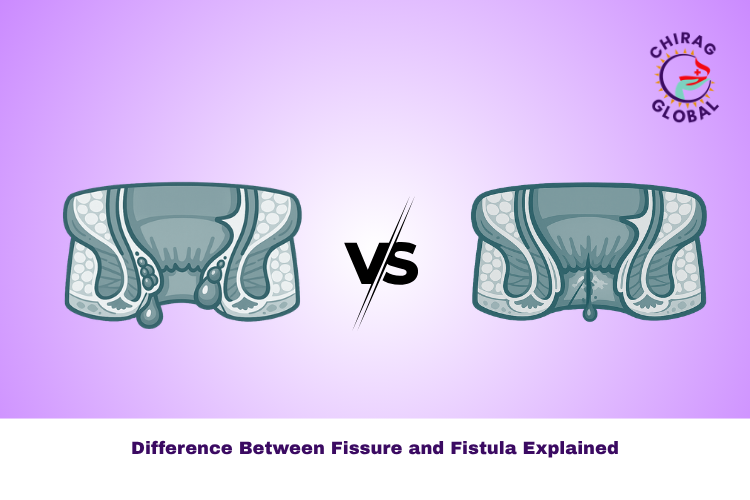
Here is where the key difference between fissure and fistula becomes clear at a structural level. While a fissure is a surface wound (a tear in the lining), a fistula is a full-thickness tunnel — a channel that forms from the inside of the anal canal through the tissue to the skin surface around the anus.
This tunnel has two openings: one inside the anal canal (internal opening, where gut bacteria continuously enter) and one on the perianal skin (external opening, where discharge comes out). Because bacteria colonise the tract continuously, the fistula cannot close on its own — ever. Surgery is always required.
Symptoms — How to Recognise the Difference Between Fissure and Fistula
Anal Fissure Symptoms
•Severe, sharp or burning pain specifically during and after bowel movements — can last 30 minutes to several hours
• Bright red blood on toilet paper or in the bowl after passing stool
• A visible crack or tear near the anus (sometimes visible in a mirror)
• A small fleshy skin tag at the outer edge of a chronic fissure (sentinel tag)
• Fear of bowel movements — avoidance that worsens constipation and the fissure further
Anal Fistula Symptoms
• Persistent discharge from an opening near the anus — pus, blood-stained fluid, or clear liquid — continuous or intermittent throughout the day (not just during bowel movements)
• Constant dull aching or pressure near the anus — not specifically linked to defecation
• Recurring abscesses that come back after apparently resolving, with severe pain
• Wetness, soiling, or odour near the anus throughout the day
• A small hole or raised opening visible in the skin near the anus
The Difference Between Fissure and Fistula
| Feature | Anal Fissure | Anal Fistula |
| What it is | A tear in the anal lining (surface wound) | A tunnel from anal canal to perianal skin |
| Primary cause | Hard stools / constipation / childbirth | Unhealed anal abscess |
| Pain type | Severe — during and after bowel movements | Dull, constant — not linked to defecation |
| Discharge | few drops of blood/ streak on stools | Pus, blood, or clear fluid all day |
| Visible sign | A crack or tear near the anus | A hole or opening near the anus |
| Heals without treatment | Acute: sometimes yes | Never — surgery always required |
| Treatment | Diet, topical creams, Anal sphincter tone optimization, improving gut health | Fistulotomy, LIFT, FiLaC laser |
Causes — Why Do Each of These Develop?
Fissure Causes
• Chronic constipation with hard, difficult stools — the most common cause
• Chronic diarrhoea — frequent loose stools also traumatise the anal lining
• Childbirth trauma — particularly posterior tears during delivery
• Low-fibre diet as the underlying dietary driver
Fistula Causes
• An anal abscess that was surgically drained or spontaneously ruptured but left a persistent infected tract — accounts for 90% of fistulas
• Crohn’s disease — associated with complex, recurrent fistulas
• Tuberculosis — an underdiagnosed cause of anal fistulas in India
Can You Have Both a Fissure and a Fistula at the Same Time?
Yes — and this is more common than most people realise. Both conditions can co-exist, and either can also occur alongside piles (haemorrhoids). This is why a thorough proctological examination matters so much — treating one condition while missing another leads to incomplete recovery and continued symptoms.
At Chirag Global Hospital, every new patient receives a comprehensive anorectal examination that checks for all co-existing conditions in a single session.
Frequently Asked Questions
How do I know which condition I have without seeing a doctor?
Key distinction: a fissure causes intense pain during bowel movements with bright red blood. A fistula causes persistent discharge and constant dull aching, with a visible hole near the anus. However, symptoms can overlap. Only a proctologist’s brief physical examination can give a definitive diagnosis.
Can a fissure turn into a fistula?
A fissure does not directly become a fistula. However, a deeply infected chronic fissure can often develop a secondary abscess, which may then lead to a fistula. The two conditions are caused by different mechanisms but can co-exist.
Which needs more urgent treatment?
Both need medical attention. A fistula with an active abscess (swelling, fever, throbbing pain) is a surgical emergency. An acute severe fissure needs prompt pain management and dietary intervention within days.
Is the examination for fissure and fistula painful at Chirag Global Hospital?
The examination is performed gently and efficiently. The digital examination takes under 60 seconds. Proctoscopy, if needed, takes 2–3 minutes. The team is experienced at making this as comfortable as possible for every patient.
| 📍 Find Chirag Global Hospital – Directions & Contact |
| View on Google Maps 📞 Call/WhatsApp: 08065916422 |