
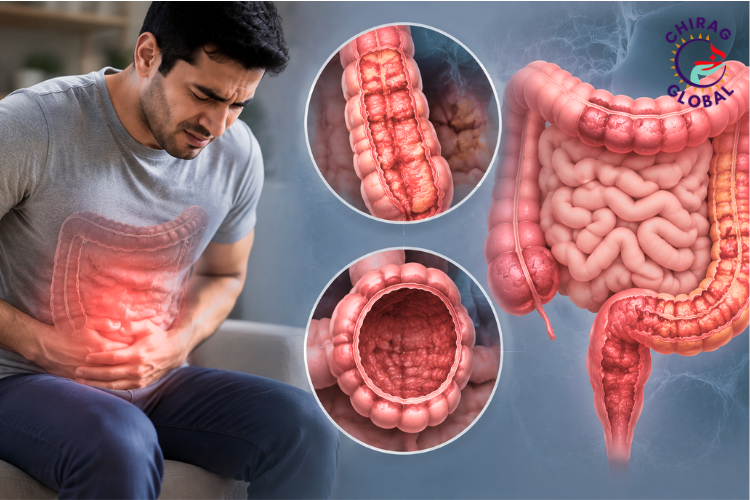
Ulcerative Colitis and Crohn’s Disease are two major types of inflammatory bowel disease (IBD) that can cause ongoing digestive symptoms and periods of flare-ups and remission. Although they share symptoms such as diarrhea, abdominal pain, fatigue, and changes in bowel habits, they are different conditions with distinct patterns of inflammation. At Chirag Global Hospitals, patients with persistent bowel symptoms can receive specialized colorectal evaluation to determine whether their symptoms may be related to ulcerative colitis, Crohn’s disease, or another gastrointestinal condition.
Understanding how these conditions differ can help patients recognize concerning symptoms, understand why diagnostic tests may be needed, and learn how treatment approaches vary between the two diseases.
Book a Consultation | Call 08065903127
What Are Ulcerative Colitis and Crohn’s Disease?
Ulcerative colitis is a chronic inflammatory bowel disease that affects the large intestine, including the colon and rectum. The inflammation usually begins in the rectum and extends upward through the colon in a continuous pattern. It mainly affects the inner lining of the bowel.
Crohn’s disease can affect almost any part of the digestive tract, from the mouth to the anus. It commonly affects the small intestine and the beginning of the large intestine. Unlike ulcerative colitis, Crohn’s disease often affects areas in a patchy or “skip” pattern, with healthy sections between areas of inflammation.
Both conditions can have periods of active symptoms, known as flares, followed by periods of remission when symptoms improve or disappear.
Ulcerative Colitis vs Crohn’s Disease: Key Differences
| Feature | Ulcerative Colitis | Crohn’s Disease |
| Main location | Colon and rectum | Any part of the digestive tract |
| Common pattern | Continuous inflammation | Patchy or skip areas |
| Rectum | Usually involved | May or may not be involved |
| Depth of inflammation | Mainly inner lining of the colon | Can involve deeper layers of the bowel wall |
| Bloody diarrhea | Common | May occur, especially when the colon is affected |
| Fistulas | Less characteristic | More characteristic |
| Strictures | Less characteristic | More common |
| Small intestine involvement | Not typical | Common |
| Surgery | Can potentially eliminate intestinal disease | Does not cure Crohn’s disease |
These differences are important because the location and depth of inflammation can influence symptoms, complications and treatment decisions.
Symptoms of Ulcerative Colitis and Crohn’s Disease
Because both conditions cause intestinal inflammation, their symptoms can overlap.
Common Symptoms
Both ulcerative colitis and Crohn’s disease may cause:
- Diarrhea
- Abdominal pain or cramping
- Fatigue
- Reduced appetite
- Weight loss
- Fever during significant inflammation
- Anemia
- Nutritional deficiencies
- Joint, skin or eye problems in some people
Symptoms can vary considerably depending on the location and severity of inflammation.
Symptoms More Commonly Associated With Ulcerative Colitis
Ulcerative colitis primarily affects the colon and rectum. Common symptoms include:
- Frequent diarrhea
- Blood in the stool
- Rectal bleeding
- Mucus in the stool
- Urgency to have a bowel movement
- Abdominal cramping
- A feeling of incomplete bowel emptying
- Fatigue
- Weight loss in more severe disease
The presence of rectal bleeding and frequent, urgent bowel movements can be particularly noticeable when ulcerative colitis is active.
What Is Tenesmus?
Some people with ulcerative colitis experience tenesmus, which is the feeling that you need to have a bowel movement even when the bowel may be empty.
This symptom can occur when inflammation affects the rectum.
Symptoms More Commonly Associated With Crohn’s Disease
Crohn’s disease can affect different parts of the digestive tract, so symptoms vary depending on the location and severity of inflammation.
Common symptoms include:
- Abdominal pain or cramping
- Persistent diarrhea
- Weight loss
- Reduced appetite
- Fatigue
- Fever
- Nausea or vomiting
- Anemia
- Nutritional deficiencies
- Joint pain
- Skin changes
- Eye inflammation
Crohn’s disease may also cause problems around the anus, including fissures, fistulas or abscesses.
How Does the Depth of Inflammation Differ?
One of the important differences between these conditions is how deeply inflammation can affect the bowel.
In ulcerative colitis, inflammation is generally limited to the mucosal lining of the colon.
In Crohn’s disease, inflammation can extend through deeper layers of the intestinal wall. This deeper inflammation can contribute to complications such as:
- Strictures
- Fistulas
- Abscesses
- Intestinal obstruction
This does not mean that every person with Crohn’s disease develops these complications. The risk depends on factors such as disease location, severity and duration.
What Causes Ulcerative Colitis and Crohn’s Disease?
The exact cause of either condition is not fully understood.
Researchers believe that several factors may contribute, including:
- Genetic factors
- Abnormal immune responses
- Changes in the gut microbiome
- Environmental factors
Neither condition is contagious, and they are not caused simply by eating a particular food.
Crohn’s disease and ulcerative colitis are chronic immune-mediated inflammatory conditions rather than infections.
How Are Ulcerative Colitis and Crohn’s Disease Diagnosed?
There is no single test that can diagnose every case of IBD.
Doctors generally consider the patient’s symptoms, medical history and examination along with appropriate investigations.
Blood and Stool Tests
Blood tests may help identify:
- Anemia
- Signs of inflammation
- Nutritional deficiencies
- Other abnormalities
Stool tests may be used to look for intestinal inflammation and help rule out infections or other causes of symptoms.
Colonoscopy and Biopsy
Endoscopic examinations allow doctors to directly examine the intestinal lining.
During a colonoscopy, small tissue samples called biopsies may be collected for microscopic examination.
This can help distinguish inflammatory bowel disease from other gastrointestinal conditions.
Imaging Tests
Imaging may be recommended when doctors need to examine areas that cannot be adequately assessed with colonoscopy or when they need to evaluate complications.
Depending on the situation, imaging may include CT or MRI-based examinations.
The diagnostic approach for Crohn’s disease is individualized and may involve multiple tests because the disease can occur in different parts of the digestive tract.
Treatment for Ulcerative Colitis
Treatment for ulcerative colitis aims to control inflammation, relieve symptoms and maintain remission.
The appropriate treatment depends on factors such as:
- Severity of symptoms
- Extent of disease
- Location of inflammation
- Previous treatment response
- Overall health
Medications
Depending on the situation, doctors may use:
- Aminosalicylates
- Corticosteroids for short-term control of active inflammation
- Immunomodulators or immunosuppressive medicines
- Biologic medicines
- Targeted small-molecule medicines
Corticosteroids are generally not used as a long-term maintenance treatment because prolonged use can cause significant side effects.
Surgery for Ulcerative Colitis
Surgery may be considered when:
- Medicines do not adequately control the disease
- Severe complications develop
- There is significant bleeding
- Toxic megacolon occurs
- Perforation develops
- Precancerous changes or colorectal cancer are identified
Removal of the colon and rectum, known as a proctocolectomy, can eliminate the intestinal disease caused by ulcerative colitis because the condition is limited to the colon and rectum.
Treatment for Crohn’s Disease
Treatment for Crohn’s disease also focuses on controlling inflammation, preventing flares and maintaining remission.
Treatment may include:
- Corticosteroids for short-term control
- Immunosuppressive or immunomodulating medicines
- Biologic therapies
- Targeted small-molecule medicines
- Nutritional support
- Surgery when complications occur
The choice of treatment depends on the location and severity of the disease and the individual’s response to previous treatments.
Surgery for Crohn’s Disease
Surgery may be needed when Crohn’s disease causes complications such as:
- Intestinal obstruction
- Strictures
- Fistulas
- Abscesses
- Severe bleeding
- Certain forms of cancer or precancerous changes
- Persistent disease that does not respond adequately to medical treatment
Unlike ulcerative colitis, surgery does not cure Crohn’s disease. Crohn’s disease can recur in another part of the digestive tract or near the site of previous surgery.
Can Surgery Cure Ulcerative Colitis?
In appropriately selected patients, removing the colon and rectum can eliminate the intestinal disease associated with ulcerative colitis.
However, surgery is a major decision and is not required for everyone. Many people manage ulcerative colitis successfully with medical treatment and regular monitoring.
A gastroenterologist and colorectal surgeon can help determine whether surgery is appropriate based on the patient’s condition.
Is Crohn’s Disease More Serious Than Ulcerative Colitis?
There is no simple answer to which condition is more serious.
Both ulcerative colitis and Crohn’s disease can range from mild to severe, and the impact varies from person to person.
Crohn’s disease can cause complications such as:
- Strictures
- Fistulas
- Abscesses
- Intestinal obstruction
- Nutritional deficiencies
Ulcerative colitis can also cause serious complications, particularly during severe flares. These may include:
- Severe bleeding
- Toxic megacolon
- Perforation of the colon
Therefore, disease severity should be assessed individually rather than assuming that one condition is always worse than the other.
Can Ulcerative Colitis Turn Into Crohn’s Disease?
Ulcerative colitis does not normally turn into Crohn’s disease.
They are considered separate forms of IBD with different patterns of inflammation.
However, in some patients, particularly when inflammation is limited to the colon, it may initially be difficult to clearly classify the condition. As more information becomes available through biopsies, imaging, follow-up examinations or surgery, the diagnosis may become clearer.
When Should You See a Doctor?
Persistent digestive symptoms should not be ignored, especially when they continue or repeatedly return.
Consider seeing a gastroenterologist if you experience:
- Persistent diarrhea
- Blood in the stool
- Recurrent abdominal pain
- Unexplained weight loss
- Persistent fatigue
- Recurrent fever
- Changes in bowel habits
- Reduced appetite
- Symptoms that interfere with daily activities
When Is Urgent Medical Attention Needed?
Seek urgent medical care for symptoms such as:
- Severe or rapidly worsening abdominal pain
- Heavy or persistent rectal bleeding
- Severe dehydration
- Persistent vomiting
- Fainting or marked weakness
- Abdominal swelling with severe pain
- Rapid deterioration during a known IBD flare
Severe ulcerative colitis and Crohn’s disease complications may require hospital treatment.
Why Getting the Correct Diagnosis Matters
Ulcerative colitis and Crohn’s disease may look similar, but their management can differ significantly.
An accurate diagnosis helps doctors determine:
- Where inflammation is located
- How extensive the disease is
- Which treatments may be appropriate
- Whether complications are developing
- How frequently monitoring is required
- Whether nutritional support is needed
- Whether surgery should be considered
Because IBD is a chronic condition, ongoing follow-up is often an important part of care.
Living With Ulcerative Colitis or Crohn’s Disease
Many people with IBD manage their condition over the long term with appropriate treatment and monitoring.
Helpful habits may include:
Follow the Treatment Plan
Take prescribed medicines as directed and discuss side effects or concerns with your healthcare team rather than stopping treatment without medical advice.
Monitor Your Symptoms
Keeping track of bowel changes, abdominal pain, weight changes and other symptoms can help your doctor understand disease activity.
Pay Attention to Nutrition
People with IBD may experience reduced appetite or nutritional deficiencies. Dietary needs vary depending on the individual’s condition, treatment and disease activity.
There is no single diet that works for everyone with IBD. A doctor or registered dietitian can provide individualized guidance when necessary.
Avoid Smoking
Smoking is particularly important to discuss with healthcare professionals if you have Crohn’s disease, as it can affect disease management and outcomes.
Attend Regular Follow-Ups
Regular monitoring allows healthcare professionals to assess symptoms, treatment response and potential complications.
How Chirag Global Hospitals Can Help
At Chirag Global Hospitals, patients with persistent digestive symptoms can undergo appropriate evaluation to identify the underlying cause.
For people with suspected or diagnosed inflammatory bowel disease, care may involve medical assessment, diagnostic investigations, medication management and surgical consultation when required.
The treatment plan is individualized according to the patient’s symptoms, disease location, severity and overall health.
Key Takeaway
Ulcerative colitis and Crohn’s disease are chronic forms of inflammatory bowel disease that can cause similar symptoms but affect the digestive tract differently.
Ulcerative colitis is limited to the colon and rectum and usually causes continuous inflammation of the inner intestinal lining. Crohn’s disease can affect any part of the digestive tract and may involve deeper layers of the bowel wall.
Because symptoms can overlap, persistent diarrhea, abdominal pain, rectal bleeding, unexplained weight loss or other ongoing digestive symptoms should be evaluated by a qualified healthcare professional.
Early assessment, an accurate diagnosis and an individualized treatment plan can help manage IBD and reduce the risk of complications.
Visit Chirag Global Hospitals Today!
Frequently Asked Questions
What is the main difference between ulcerative colitis and Crohn’s disease?
Ulcerative colitis affects the colon and rectum and usually causes continuous inflammation beginning in the rectum. Crohn’s disease can affect any part of the digestive tract and often causes patchy areas of inflammation.
Which condition causes more blood in the stool?
Blood in the stool is particularly common in ulcerative colitis, although Crohn’s disease can also cause bleeding, especially when the colon is affected.
Can Crohn’s disease affect the anus?
Yes. Crohn’s disease can cause perianal problems such as fissures, fistulas and abscesses.
Can ulcerative colitis be cured?
Removal of the colon and rectum can eliminate the intestinal disease caused by ulcerative colitis. However, surgery is not necessary for every patient, and many people manage the condition with medication and monitoring.
Are ulcerative colitis and Crohn’s disease the same condition?
No. Both are forms of inflammatory bowel disease, but they have different patterns, locations and depths of inflammation.
Can a person have symptoms of both conditions?
Yes, symptoms can overlap significantly. This is why medical evaluation and appropriate diagnostic testing are important for distinguishing between the two.