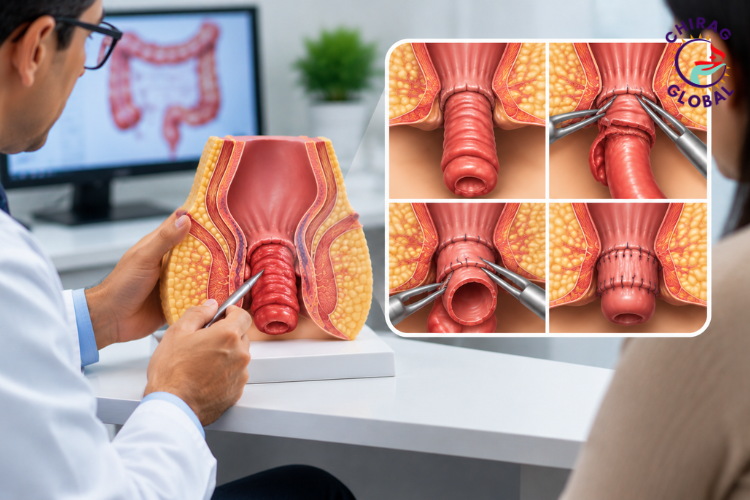

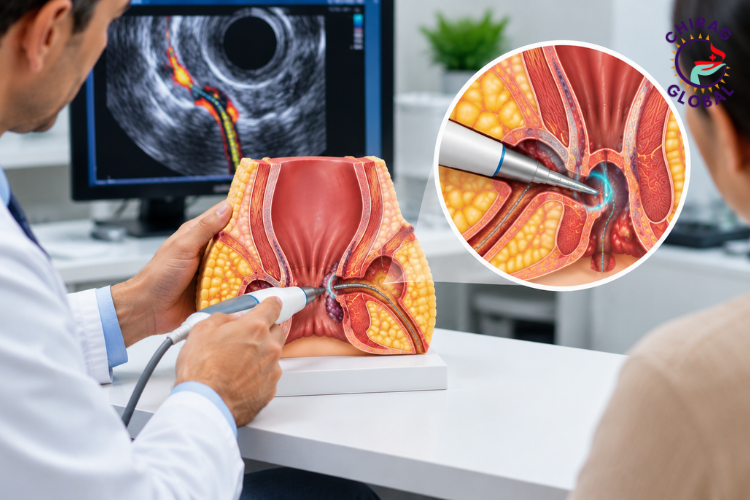
An anal fistula is an abnormal tunnel connecting the anal canal or rectum to the skin near the anus. The external opening may look small, but the tract can extend deeper, have branches or connect to an internal opening that is difficult to identify from the outside. Its relationship with the anal sphincter also matters when planning treatment.
CEREG for anal fistula uses real-time echo guidance to help assess and map this anatomy during treatment planning and, where applicable, during the procedure. For patients with unclear, complex or recurrent fistulas, detailed anatomical assessment can help the surgeon choose a treatment approach more carefully.
At Chirag Global Hospitals in Bangalore, patients can undergo specialist assessment to understand the fistula anatomy and discuss whether an echo-guided approach is appropriate.
If you have recurrent discharge, swelling or a wound near the anus that keeps opening and closing, arrange a specialist evaluation at Chirag Global Hospitals, Bangalore.
Book a Consultation | Call 08065903127
What is CEREG for anal fistula?
CEREG is used to describe Circumferential Endoanal Real-Time Echo-Guided procedures. The approach uses real-time echo or ultrasound guidance to improve visualisation of the fistula anatomy rather than relying only on external examination.
The assessment focuses on structures such as the fistula tract, internal opening and its relationship with surrounding tissues. This information can help guide treatment planning and, depending on the clinical protocol, the procedure itself.
CEREG is not a universal name for every type of anal fistula surgery. The exact equipment, steps and treatment technique can vary between centres. Patients should therefore ask their surgeon what the CEREG protocol involves and why it is being recommended for their fistula.
What makes echo-guided fistula treatment different?
1. It focuses on three-dimensional anatomy
An anal fistula is not simply a skin opening. The tract can travel in different directions and may involve or approach the sphincter.
Real-time echo guidance can add anatomical information that may not be apparent during an external examination.
2. It can support fistula tract mapping
For a complex or recurrent fistula, identifying the internal opening and any secondary tracts is important. Echo guidance can contribute to this mapping and help the surgeon understand the course of the fistula.
3. It keeps sphincter anatomy in focus
The anal sphincter is important for bowel control. Treatment therefore needs to balance fistula control with preservation of healthy sphincter muscle.
CEREG may provide additional anatomical information when this relationship needs closer assessment.
4. It can be useful when anatomy is difficult to define
Previous surgery, recurrent disease, multiple openings or branching tracts can make fistula anatomy more difficult to interpret. In selected patients, detailed imaging can support more informed treatment planning.
CEREG vs conventional anal fistula treatment
CEREG should not be viewed as a replacement for every established fistula operation. The key difference is the use of real-time echo guidance as part of anatomical assessment and treatment planning.
Conventional care may involve clinical examination, imaging performed before surgery and direct findings during the operation. An echo-guided approach can add real-time ultrasound information to that process.
The appropriate treatment still depends on:
- Whether the fistula is simple or complex
- Sphincter involvement
- Presence of an abscess
- Previous fistula surgery
- Number and location of openings
- Associated conditions such as Crohn’s disease
Treatment options may include fistulotomy, seton-based treatment, LIFT, advancement flap or other sphincter-preserving approaches. The choice should be based on the individual fistula rather than the procedure name alone.
Considering anal fistula treatment in Bangalore? Discuss your fistula history, previous procedures and treatment options with the proctology team at Chirag Global Hospitals.
How is CEREG used in fistula assessment?
Step 1: Clinical examination
The surgeon reviews symptoms, previous abscesses or operations, external openings, discharge and signs of active infection.
Step 2: Fistula mapping
The team assesses the internal opening, primary tract, possible branches and relationship with the sphincter. CEREG adds real-time echo guidance to this anatomical assessment.
Step 3: Treatment planning
Once the fistula pattern is understood, the surgeon selects an appropriate treatment. Depending on the anatomy, this may involve fistulotomy, seton treatment, LIFT, advancement flap or another approach.
Step 4: Follow-up
Follow-up helps assess wound healing, drainage, pain, bowel function and signs of persistent or recurrent disease.
Who may be considered for echo-guided fistula assessment?
CEREG may be considered when detailed anatomical information is useful, including in some patients with:
- Recurrent anal fistula
- Complex or branching fistula
- An unclear internal opening
- Multiple external openings
- Previous fistula surgery
- Suspected sphincter involvement
Not every patient needs CEREG. A straightforward fistula may be adequately assessed through clinical examination and standard treatment planning. MRI or conventional endoanal ultrasound may also be appropriate in selected cases.
Does CEREG prevent anal fistula recurrence?
No fistula procedure can guarantee that recurrence will never occur.
Recurrence can be influenced by the fistula’s anatomy, missed branches or internal openings, associated disease, previous surgery and healing. Better anatomical assessment can help inform treatment planning, but it does not remove all recurrence risk.
The goal is to understand the fistula accurately and select treatment that balances disease control with preservation of sphincter function.
Is CEREG suitable for every anal fistula?
No. Treatment should be diagnosis-led.
A different approach may be recommended when there is an acute abscess requiring drainage, significant sphincter involvement or an underlying condition such as Crohn’s disease. The surgeon may also recommend MRI or another imaging method when it is more appropriate for the clinical question.
For patients, the useful question is not simply, “Is CEREG better?” It is, “What does my fistula anatomy show, and how will this information change my treatment plan?”
Why accurate fistula mapping matters
The most important part of fistula treatment is understanding what lies beneath the skin.
A small external opening can connect to a tract that travels around or through the sphincter and may have secondary extensions. If part of the tract or internal opening remains unidentified, persistent drainage or recurrence may occur.
That is why modern anal fistula care emphasises careful examination, appropriate imaging when indicated, anatomical mapping and treatment selection based on sphincter involvement.
For anyone considering CEREG for anal fistula in Bangalore, a specialist assessment is the right starting point.
What should you ask your fistula surgeon?
Before treatment, consider asking:
- Where is the internal opening?
- Is my fistula simple, complex or recurrent?
- Does it involve the anal sphincter?
- Are there secondary tracts?
- Do I need MRI or another imaging test?
- Why is this treatment recommended for my anatomy?
- What are the possible effects on bowel control?
- What should I expect during recovery and follow-up?
These questions can help you understand the reasoning behind the treatment plan.
CEREG for anal fistula at Chirag Global Hospitals
If you are looking for anal fistula treatment in Bangalore, Chirag Global Hospitals provides specialist proctology assessment for fistula and other anorectal conditions.
The focus is on understanding the fistula anatomy, assessing its complexity and selecting treatment according to the individual patient’s needs. Where appropriate, imaging or echo-guided assessment may be considered as part of the diagnostic and treatment-planning process.
Looking for specialist anal fistula care in Bangalore?
Visit Chirag Global Hospitals!
FAQs About CEREG for Anal Fistula
What is CEREG for anal fistula?
CEREG refers to a Circumferential Endoanal Real-Time Echo-Guided approach that uses real-time echo or ultrasound information to assess fistula anatomy and support treatment planning. The exact technique can vary between centres.
How does echo guidance help with an anal fistula?
Echo guidance can provide additional information about the fistula tract, internal opening, secondary extensions and relationship with the anal sphincter. This may be particularly useful when the anatomy is complex or recurrent.
Is CEREG better than MRI for anal fistula?
CEREG and MRI serve different roles and should not automatically be considered alternatives. MRI can provide detailed imaging of fistula anatomy, while an echo-guided approach can provide real-time anatomical information. The appropriate investigation depends on the patient’s condition and the clinical question.
Is CEREG suitable for complex anal fistula?
It may be considered in selected patients with complex or recurrent fistulas where detailed anatomical assessment is important. Suitability should be determined after a specialist examination.
Can CEREG prevent anal fistula recurrence?
No procedure can guarantee that an anal fistula will not recur. Careful identification of the fistula anatomy can support treatment planning, but recurrence depends on several factors, including fistula complexity, associated disease and healing.
Does every anal fistula need echo-guided treatment?
No. Some straightforward fistulas can be assessed and treated without specialised echo-guided procedures. The need for CEREG, MRI or another imaging method depends on the individual anatomy and clinical findings.
How is the right anal fistula treatment selected?
Treatment is selected based on factors such as the fistula’s location, internal opening, sphincter involvement, complexity, recurrence history and associated conditions. Options can include fistulotomy, seton treatment, LIFT, advancement flap and other approaches.