
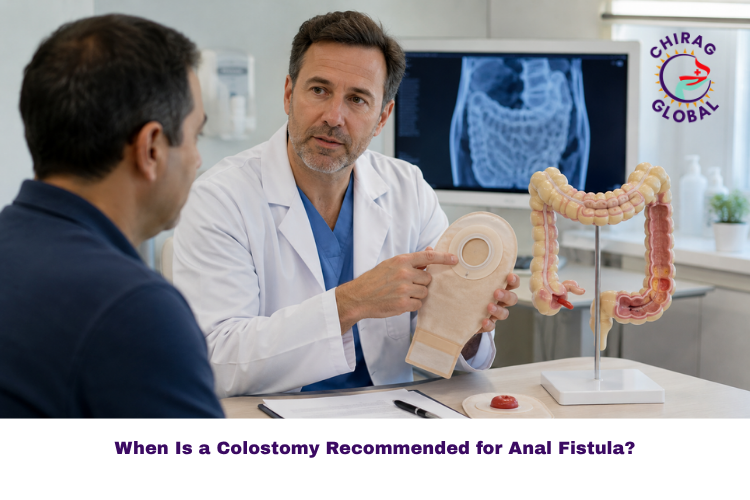
Being diagnosed with an anal fistula can be stressful, and many patients worry about the possibility of needing a colostomy. One of the most common questions asked is, “Will I need a colostomy for my fistula?” In reality, the vast majority of anal fistulas do not require a colostomy. Most simple and many complex fistulas can be treated with procedures such as fistulotomy, seton placement, LIFT, VAAFT, or other sphincter-preserving techniques.
However, in certain complex or high-risk situations, a colostomy for fistula patients may be recommended to temporarily divert stool away from the affected area. This allows severe infections to settle, promotes wound healing, and reduces the risk of further complications. Permanent colostomies for anal fistulas are uncommon and are generally considered only in exceptional circumstances.
At Chirag Global Hospitals, Bangalore, experienced colorectal surgeons carefully evaluate each patient’s condition before recommending treatment. A colostomy is considered only when it is likely to improve healing or protect the patient from serious complications.
This guide explains when a colostomy for fistula patients may be necessary, how it helps, and what patients can expect during recovery.
Book a Consultation | Call 08065903127
What Is a Colostomy?
A colostomy is a surgical procedure in which a portion of the large intestine (colon) is brought through an opening created in the abdominal wall, known as a stoma.
Instead of passing through the rectum and anus, stool exits through the stoma into a specially designed colostomy bag attached to the skin.
A colostomy may be:
- Temporary
- Permanent
For fistula patients, it is more commonly temporary.
Why Would a Fistula Patient Need a Colostomy?
The primary purpose of a colostomy for fistula patients is to divert stool away from the infected or healing anorectal area.
This helps by:
- Reducing contamination of the surgical site
- Allowing wounds to heal more effectively
- Controlling severe infection
- Protecting complex reconstructive procedures
- Reducing inflammation
The decision depends entirely on the severity and complexity of the disease.
Do Most Anal Fistulas Require a Colostomy?
No.
Most patients with anal fistulas do not require a colostomy.
Many fistulas can be successfully treated using procedures such as:
- Fistulotomy
- Seton placement
- LIFT procedure
- VAAFT
- Advancement flap surgery
- Other sphincter-preserving techniques
A colostomy is usually reserved for selected complex situations.
When Is a Colostomy Needed for Fistula Patients?
Although uncommon, a colorectal surgeon may recommend a colostomy for fistula patients in specific circumstances.
Extensive or Complex Anal Fistulas
Patients with multiple fistula tracts or extensive disease involving significant portions of the anal sphincter may benefit from temporary stool diversion to support healing.
Severe Perianal Infection
When a fistula is associated with widespread infection or significant tissue destruction, diverting stool can reduce contamination while the infection is treated.
Recurrent Fistulas
Patients who have undergone multiple previous fistula surgeries without successful healing may require temporary diversion during further reconstructive procedures.
Crohn’s Disease-Related Fistulas
Some patients with severe Crohn’s disease develop complex perianal fistulas that do not respond adequately to medications or repeated procedures.
In carefully selected cases, a temporary colostomy may help control inflammation and promote healing.
Large Perineal Wounds
When fistula surgery leaves a substantial wound or involves complex reconstruction, reducing stool passage through the anal canal may improve postoperative healing.
Failed Previous Repairs
If previous fistula repair procedures repeatedly fail because of ongoing contamination or infection, temporary fecal diversion may be considered.
Severe Tissue Damage
Patients with extensive injury to the tissues surrounding the anus may benefit from temporary diversion while healing occurs.
How Does a Colostomy Help Fistula Healing?
Normally, stool passes through the rectum and anal canal several times a day.
In patients with severe fistula disease, this can:
- Irritate healing tissues
- Introduce bacteria
- Delay wound healing
- Increase infection risk
A colostomy for fistula patients diverts stool away from the affected area, allowing the wound to remain cleaner and reducing mechanical stress during recovery.
Is the Colostomy Permanent?
In most fistula patients, no.
Temporary colostomies are more common.
Once:
- Infection has resolved
- Wounds have healed
- The fistula repair is successful
- The surgeon confirms adequate healing
A second operation may be performed to reverse the colostomy.
Permanent colostomies are generally reserved for uncommon situations involving severe anorectal disease or when restoring normal bowel continuity is not considered safe.
What Happens During Colostomy Surgery?
During the procedure:
- The patient receives general anesthesia.
- The surgeon creates an opening (stoma) on the abdominal wall.
- A portion of the colon is brought through the opening.
- The colon is secured to the skin.
- A colostomy bag is fitted to collect stool.
The specific surgical approach depends on the patient’s overall condition and associated procedures.
Recovery After Colostomy Surgery
Recovery varies depending on:
- Overall health
- Complexity of fistula surgery
- Presence of infection
- Additional procedures performed
Many patients gradually resume routine daily activities within several weeks, although complete recovery may take longer.
Regular follow-up is essential.
Possible Risks of Colostomy
Like any surgical procedure, colostomy may involve certain risks, including:
- Infection
- Bleeding
- Skin irritation around the stoma
- Stoma narrowing
- Stoma prolapse
- Hernia around the stoma
- Leakage from the appliance
Most complications can be managed with early medical attention and appropriate stoma care.
Can a Fistula Heal Without a Colostomy?
Yes.
The majority of anal fistulas heal successfully without requiring stool diversion.
Modern colorectal surgery offers several effective treatment options depending on the fistula’s anatomy and complexity.
Your surgeon will recommend the least invasive approach that provides the best chance of healing while preserving continence.
Visit Chirag Global Hospitals Today!
Conclusion
A colostomy for fistula patients is not routinely required and is generally reserved for complex situations where temporary stool diversion can improve healing and reduce the risk of complications. Most anal fistulas can be effectively treated with sphincter-preserving procedures or fistulotomy without the need for a stoma. When a colostomy is recommended, it is often a temporary measure designed to support recovery and improve the success of fistula treatment.
If you have been diagnosed with an anal fistula or have been advised that a colostomy may be necessary, the experienced colorectal specialists at Chirag Global Hospitals, Bangalore, can provide a comprehensive evaluation, explain your treatment options, and develop a personalized care plan focused on achieving the best possible long-term outcome.
Frequently Asked Questions
Does every anal fistula require a colostomy?
No. Most anal fistulas are treated successfully without a colostomy. Stool diversion is usually reserved for selected complex or high-risk cases.
Is a colostomy for fistula patients permanent?
Usually not. In many cases, the colostomy is temporary and may be reversed after the fistula has healed and the surgeon confirms it is safe to restore normal bowel continuity.
Why does diverting stool help fistula healing?
A colostomy keeps stool away from the healing area, reducing contamination, lowering the risk of infection, and allowing damaged tissues to recover more effectively.
Can I live normally with a temporary colostomy?
Yes. With proper education and support, many people continue working, travelling, exercising, and performing everyday activities while living with a temporary colostomy.
How does my surgeon decide if I need a colostomy?
The decision depends on factors such as the complexity of the fistula, the presence of severe infection, associated conditions like Crohn’s disease, previous failed surgeries, and the extent of tissue damage.