
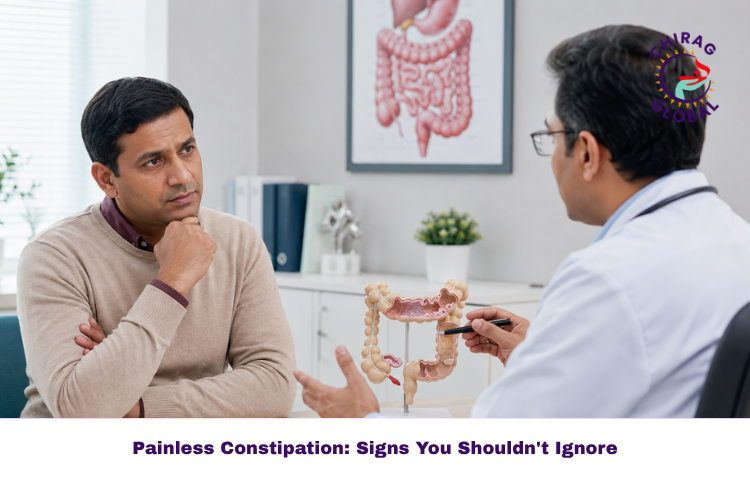
Constipation is often associated with abdominal pain, bloating, or difficulty passing stool. But painless constipation can be easier to overlook. A person may continue going about their daily routine without discomfort while bowel movements gradually become less frequent, stools become harder, or emptying the bowel becomes increasingly difficult.
The absence of pain does not necessarily mean that bowel function is normal.
Some people naturally have bowel movements less frequently than others, and bowel frequency alone does not define constipation. However, a persistent change from your usual bowel pattern, hard stools, excessive straining, or a feeling that the bowel has not emptied properly can indicate constipation even when there is no pain.
At Chirag Global Hospitals, Bangalore, persistent bowel symptoms can be evaluated to identify whether constipation is related to lifestyle factors or whether an underlying anorectal or gastrointestinal condition needs attention.
Book a Consultation | Call 08065903127
What Is Painless Constipation?
Painless constipation refers to constipation symptoms occurring without significant abdominal or rectal pain.
It can involve:
- Passing stools less frequently than usual
- Hard or dry stools
- Straining during bowel movements
- Spending unusually long periods on the toilet
- Feeling that stool has not completely passed
- Needing to make repeated attempts to empty the bowel
- A noticeable change in normal bowel habits
Someone may have several of these symptoms without experiencing obvious pain.
This is one reason constipation can continue for a long time before a person seeks medical advice.
Is It Normal to Have Bowel Movements Every Few Days?
Not necessarily a problem.
There is no single bowel movement frequency that is considered normal for everyone. Some healthy people naturally pass stool more than once a day, while others may go every few days.
What matters is your usual pattern and how easily you pass stool.
For example, someone who normally has bowel movements every two days without straining, pain, or other symptoms may not necessarily be constipated.
On the other hand, someone who previously passed stool daily but now goes several days without a bowel movement and has hard stools or difficulty emptying may be experiencing constipation.
A change in bowel habits can be more meaningful than a specific number of bowel movements.
Why Can Constipation Happen Without Pain?
Constipation develops for different reasons, and pain is not required for it to occur.
Low Fibre Intake
Fibre adds bulk to stool and can support regular bowel movements.
A diet consistently low in fibre may contribute to harder or less frequent stools.
Common sources of dietary fibre include:
- Vegetables
- Fruits
- Whole grains
- Legumes
- Nuts and seeds
Increasing fibre gradually is generally preferable to making a sudden, very large dietary change.
Not Drinking Enough Fluids
When the body does not receive enough fluid, stool can become harder and more difficult to pass.
However, simply drinking excessive amounts of water is not a treatment for every cause of constipation.
Fluid requirements vary between individuals, particularly for people with certain medical conditions.
Low Physical Activity
Regular physical activity supports normal bowel function.
Long periods of sitting, reduced mobility, or prolonged inactivity can contribute to constipation in some people.
Even routine movement throughout the day may be helpful for maintaining bowel regularity.
Ignoring the Urge to Pass Stool
Repeatedly postponing bowel movements can interfere with normal bowel habits.
When the urge is consistently ignored, stool may remain in the colon longer, allowing more water to be absorbed and making it harder.
Over time, this can contribute to a cycle of difficult bowel movements.
Could Painless Constipation Be Caused by Medication?
Yes.
Some medicines and supplements can contribute to constipation.
Examples include:
- Certain opioid pain medicines
- Iron supplements
- Some antacids
- Certain antidepressants
- Some blood-pressure medicines
- Certain medicines used for neurological conditions
If constipation begins after starting a medication, do not stop a prescribed medicine without speaking with your doctor.
A healthcare professional can determine whether the medication could be contributing and whether an alternative or additional treatment is appropriate.
When Does Painless Constipation Become Chronic?
Constipation becomes more concerning when it persists rather than being an occasional change.
Chronic constipation may involve ongoing difficulty passing stool, hard stools, excessive straining, or incomplete bowel evacuation over an extended period.
Someone can have chronic constipation without experiencing significant pain.
That is why the absence of pain should not be the only factor used to decide whether constipation needs attention.
Can Painless Constipation Be a Sign of an Underlying Bowel Problem?
Sometimes.
Most constipation is related to functional, dietary, lifestyle, medication, or other non-serious causes. However, persistent constipation can occasionally be associated with an underlying gastrointestinal or colorectal condition.
Possible causes may include:
- Pelvic-floor dysfunction
- Irritable bowel syndrome with constipation
- Structural problems affecting bowel passage
- Certain neurological disorders
- Metabolic conditions
- Medication-related constipation
- Narrowing or obstruction of the bowel
The appropriate evaluation depends on the individual’s symptoms, age, medical history, medications, and changes in bowel habits.
When Should You See a Doctor for Painless Constipation?
Consider medical evaluation when constipation:
- Persists despite lifestyle changes
- Keeps returning
- Represents a significant change from your normal bowel pattern
- Requires frequent use of laxatives
- Causes difficulty completely emptying the bowel
- Is accompanied by rectal bleeding
- Occurs with unexplained weight loss
- Is associated with persistent bloating
- Occurs alongside vomiting
- Is accompanied by an inability to pass stool or gas
You do not have to wait for severe pain before seeking medical advice.
Treatment for Painless Constipation
Treatment depends on the underlying cause.
For some people, improving diet, activity, hydration, and bowel habits may be sufficient.
Others may need:
- Fibre supplementation
- Stool-softening measures
- Laxatives recommended by a healthcare professional
- Treatment for an underlying anorectal condition
- Pelvic-floor therapy
- Further investigation of persistent symptoms
If constipation is caused by medication or another medical condition, addressing that underlying factor may be an important part of treatment.
Painless Constipation: When Is It an Emergency?
Constipation without pain is generally not an emergency by itself.
However, seek urgent medical attention if constipation occurs with:
- Severe or rapidly increasing abdominal pain
- Persistent vomiting
- Significant abdominal swelling
- Inability to pass stool and gas
- Heavy rectal bleeding
- Fever with significant abdominal or rectal symptoms
- Severe weakness or dehydration
These symptoms may indicate a more serious problem requiring prompt assessment.
Conclusion
Painless constipation can be easy to overlook because there may be no obvious discomfort. However, bowel health is not determined by pain alone.
Hard stools, repeated straining, incomplete bowel evacuation, a significant change in bowel habits, or persistent constipation can all indicate that your bowel routine needs attention.
Occasional constipation may improve with appropriate dietary and lifestyle changes. But if constipation continues, repeatedly returns, or occurs alongside warning signs such as rectal bleeding, unexplained weight loss, vomiting, abdominal swelling, or inability to pass stool or gas, medical evaluation is important.
At Chirag Global Hospitals, Bangalore, persistent constipation and associated colorectal symptoms can be evaluated to identify the underlying cause and determine an appropriate treatment approach.
Visit Chirag Global Hospitals Today!
Frequently Asked Questions
Can you be constipated without pain?
Yes. Constipation can occur without abdominal or rectal pain. Hard stools, excessive straining, infrequent bowel movements, or incomplete evacuation can occur even when a person feels otherwise comfortable.
Is painless constipation dangerous?
Painless constipation is not necessarily dangerous, particularly when it is occasional. However, persistent constipation or a significant change in bowel habits should not be ignored.
How long can constipation last before seeing a doctor?
There is no single timeframe that applies to everyone. If constipation persists, repeatedly returns, or does not improve with reasonable lifestyle measures, medical evaluation is appropriate.
Is going to the toilet every three days constipation?
Not necessarily. Bowel frequency varies between people. If stools pass easily and there are no other symptoms, this may be normal for that individual. A change from your usual pattern is more important.
Can constipation cause hemorrhoids?
Repeated straining and hard stools can contribute to hemorrhoid symptoms. Managing constipation can help reduce pressure on the anal region.
Can painless constipation cause fecal impaction?
Severe or prolonged constipation can sometimes lead to fecal impaction, where hardened stool becomes lodged and difficult to pass.